
Gold Tone Cripple Creek Banjos: Every Model, Explained
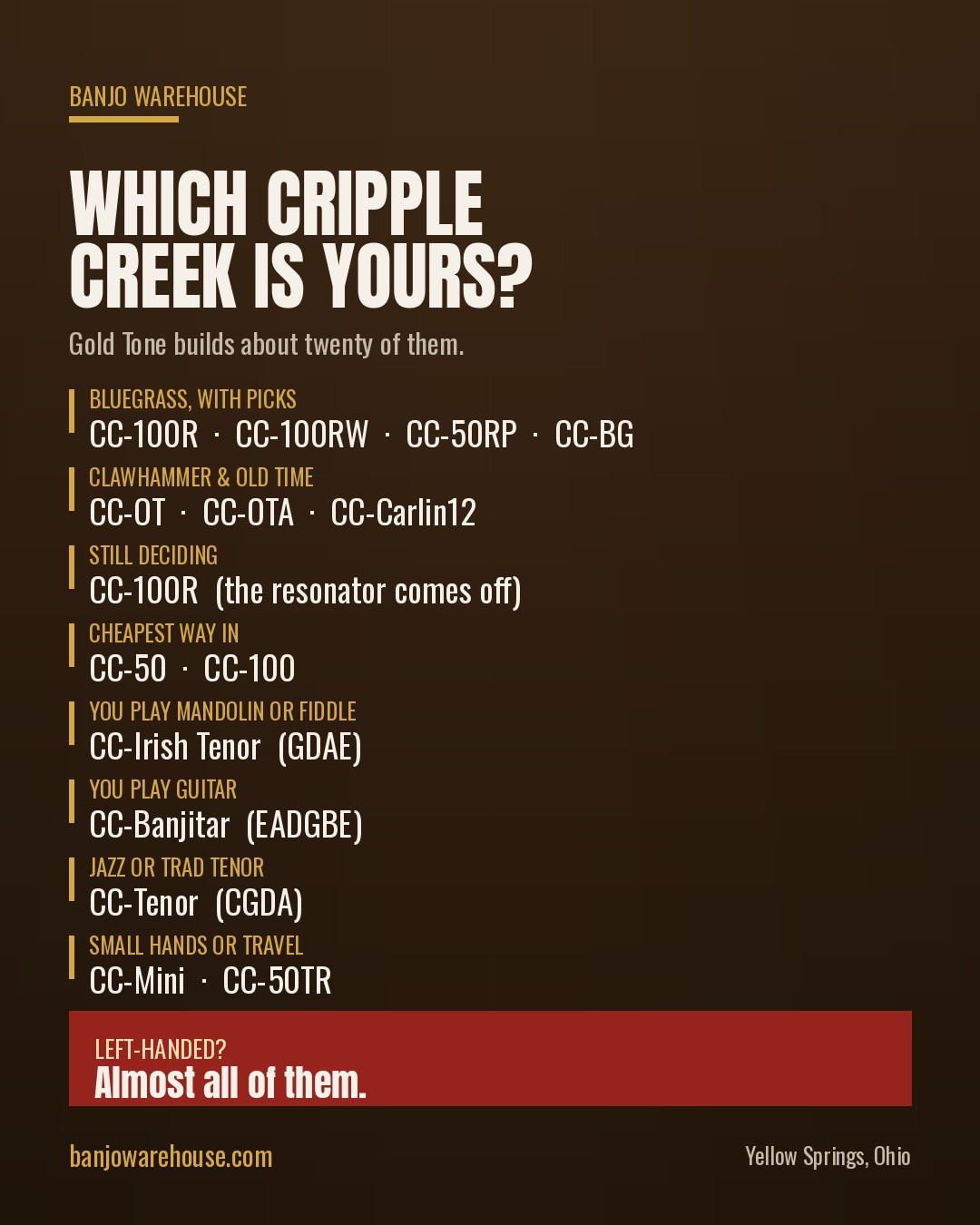
Gold Tone Cripple Creek banjos are the company’s entry level line, and they are the banjos I sell more of than anything else in the shop. It is also the most confusing line they make, because “Cripple Creek” covers about twenty different instruments: 5-strings, tenors, a plectrum, a banjitar, a travel banjo and a mini. Some have resonators, some do not. Two of them are not even tuned to G.
This page sorts them out. I have had nearly all of these on the bench, so what follows is how I would steer you, not a spec sheet.
Start with two questions
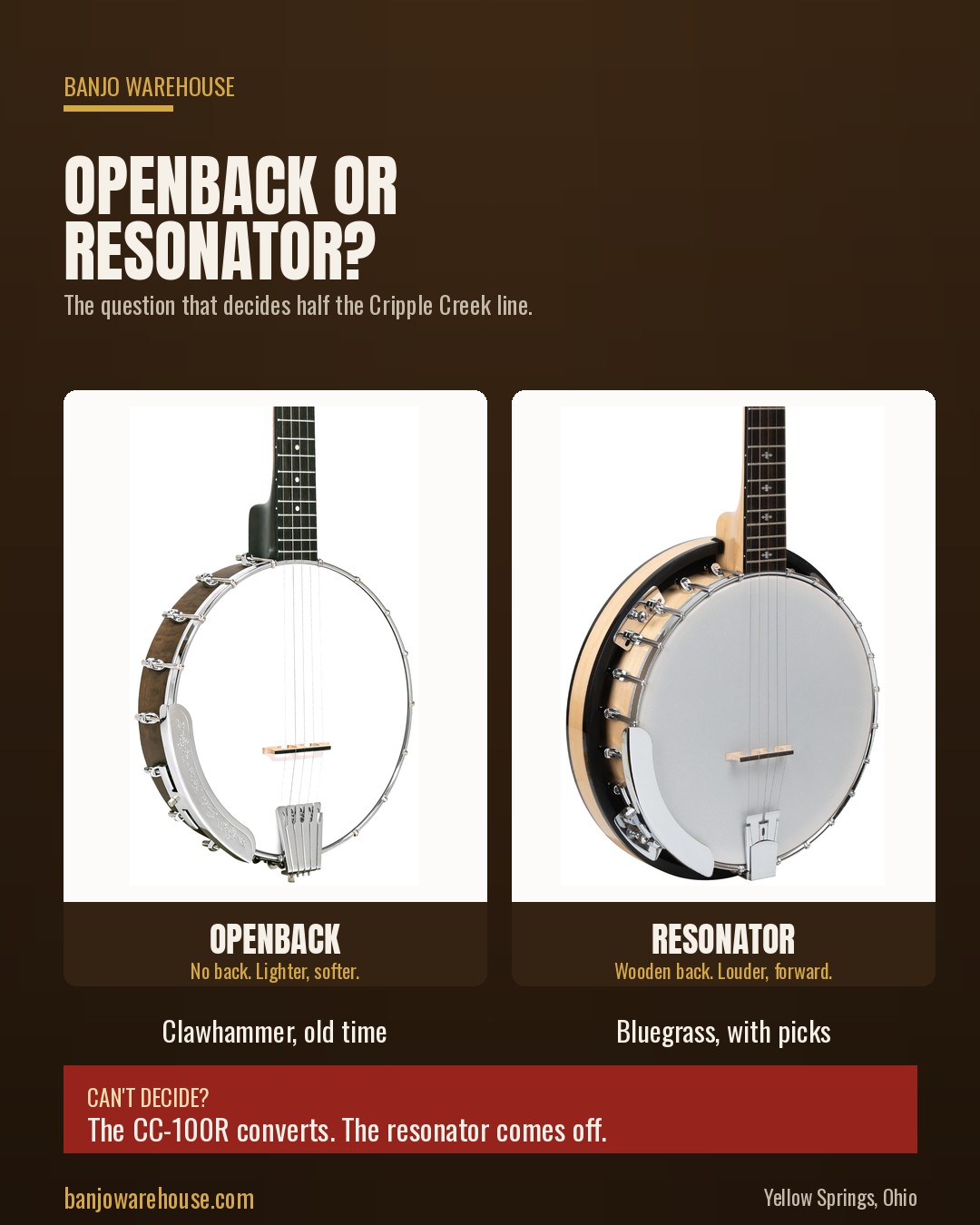
One: what music do you want to play? Bluegrass with fingerpicks wants a resonator, the wooden bowl on the back that throws sound forward. Clawhammer and old time want an openback, which is lighter and softer. That single answer eliminates half this line.
Two: five strings, or something else? Nearly everyone wants a 5-string. But if you are coming from mandolin, fiddle or guitar, Gold Tone builds Cripple Creeks in your tuning, and most people never find out.
If you are torn between two specific models, I wrote a longer head to head here: Gold Tone CC-BG vs CC-100R.
The 5-string core
This is where most people land.
- CC-50 is the entry point of the whole line. Openback, no resonator, the lightest and least expensive way into a real banjo.
- CC-100 is the openback a step up, with a maple neck and better hardware.
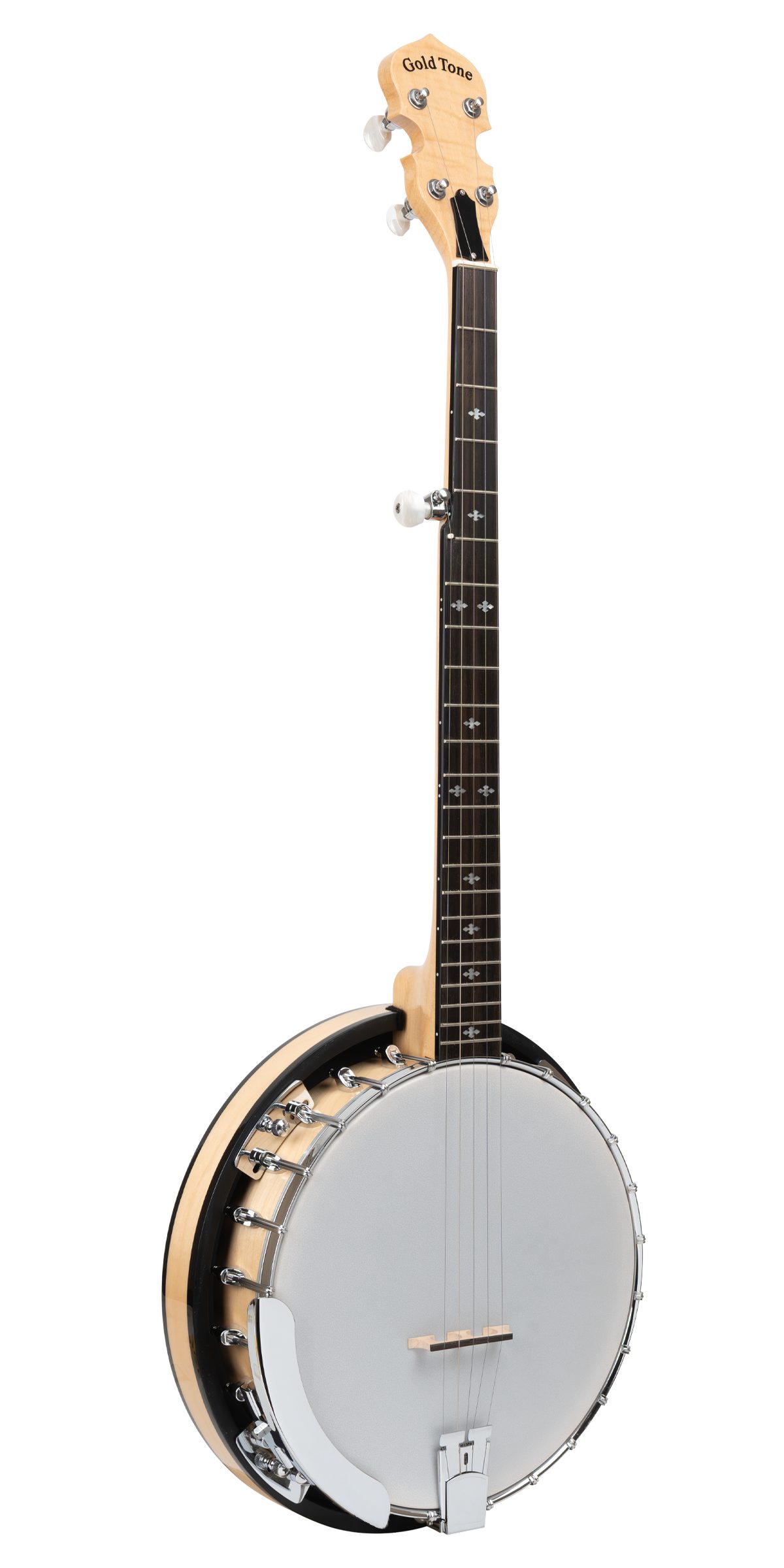
- CC-100R is the one I recommend most often. It is a convertible: the resonator comes off, so you can play bluegrass one night and clawhammer the next without owning two banjos. If you do not know yet which way you are going, this is the safe answer.
- CC-100RW is the same idea with a wide fingerboard. Worth a serious look if you have large hands, and the reason a lot of people quit the banjo is that nobody told them this existed.
- CC-50RP is a resonator banjo with planetary tuners, which turn more smoothly and hold better than friction pegs.

Two of these also come with a pickup fitted, if you expect to plug in: CC-100+ and CC-100R+.
Clawhammer and old time
If you already know you want to frail, do not start with a general purpose banjo and adapt it. Gold Tone builds these for the style.
- CC-OT is where I send most beginning clawhammer players. Fiberskyn head for that muted, earthy thump, a rolled brass flat bar tone ring, and a scooped fingerboard so you can strike over the head. This is a real old time banjo, not a stripped down beginner box.
- CC-OTA is the same banjo in A scale, a shorter neck tuned up to aEAC#E. Old time players who spend their night in A will know why they want this. If that sentence meant nothing to you, take the CC-OT.
- CC-Carlin12 is the Bob Carlin signature on a 12 inch head, which gives a deeper and woodier voice than the standard 11 inch.
For how these compare to openbacks outside this line, see my picks for clawhammer banjos.
Starting from nothing
The CC-BG is the bluegrass starter package: the banjo plus the things you would otherwise have to work out and buy separately. If you have never owned a banjo and do not want to assemble a shopping list, start here. If you are not sure whether you want bluegrass or old time, the CC-100R above is the more flexible buy.
See also: my honest picks for beginner banjos.
Not tuned to G
This is the part of the line almost nobody knows about, and it is the reason a lot of musicians think the banjo is closed to them.
- CC-Irish Tenor is tuned GDAE, the same as a mandolin or fiddle. If you play either, you already know this fingerboard.
- CC-Tenor is tuned CGDA, the jazz and traditional tenor tuning.
- CC-Plectrum is a four string with a long neck, tuned CGBD, played with a flatpick.
- CC-Banjitar is six strings tuned EADGBE. It is a guitar neck on a banjo body, with a pickup fitted. Guitar players can play it the day it arrives.
Small and portable
- CC-Mini is a short scale banjo tuned CGCEG. Good for small hands, for children, and for anyone who wants a banjo that lives on the couch instead of in a case.
- CC-50TR Traveler is the openback built to go with you, tuned aEAC#E.
Left-handed Cripple Creeks
Almost every Cripple Creek comes left-handed, and that is unusual. Most shops carry one or two lefty banjos as a gesture. Gold Tone actually builds the line both ways, and we list them.
- CC-50/L openback
- CC-100/L openback
- CC-100+/L with pickup
- CC-100R/L convertible resonator
- CC-100R+/L with pickup
- CC-50RP/L with planetary tuners
- CC-BG/L starter pack
- CC-OT/L clawhammer package
- CC-OTA/L A scale clawhammer
- CC-Carlin12/L Bob Carlin 12 inch
- CC-Tenor/L
- CC-Irish Tenor/L
- CC-Plectrum/L
- CC-Banjitar/L six string
- CC-Mini/L
- CC-50TR/L Traveler
If you are left-handed and someone told you to learn right-handed because lefty banjos do not exist, they were wrong, and they cost you time.
What we do before it ships
Every Cripple Creek that goes out of here is set up by hand by Tara, our banjo tech, on top of the factory setup in Titusville. Action, bridge placement, intonation, truss rod. On an entry level banjo this matters more than it does on an expensive one, because a badly set up beginner banjo is the single most common reason people quit.
Free shipping anywhere in the US. 7-day money-back guarantee. Fifth string spikes are free if you want them. Financing through PayPal Pay in 4.
Call Geoff directly at (404) 218-8580 if you want to talk through which one fits. Tell me what records you like and I will tell you what to buy.
Want to know when new banjos arrive? Join our email list
Which Cripple Creek is best for a complete beginner?
The CC-100R, because the resonator comes off. You do not have to decide between bluegrass and clawhammer before you have played a note. If you want everything in one box, take the CC-BG.
What is the difference between the CC-50 and the CC-100?
Both are openbacks. The CC-100 is the step up, with a better neck and better hardware. The CC-50 is the least expensive way into a real banjo.
Do Cripple Creek banjos come left-handed?
Almost all of them, including the tenor, the plectrum, the banjitar and the clawhammer packages. They are listed above.
Are Cripple Creek banjos good enough to keep?
For most players, yes, for years. They are built in Titusville, Florida with real tone rings and real hardware, not stamped parts. People do eventually move up, but they move up because they want a different sound, not because the Cripple Creek failed them.
Where are Cripple Creek banjos made?
Gold Tone builds and sets them up at its workshop in Titusville, Florida.
See the rest of what we carry from this maker: all Gold Tone banjos at Banjo Warehouse.
Contact Banjo Warehouse
For detailed descriptions or to chat about banjos, call Geoff Hohwald at (404) 218-8580.
Email us anytime at [email protected].
Follow Banjo Warehouse:
- Facebook – Join our community
- YouTube – Watch demos and lessons
- GeoffHohwald.com – Banjo lessons and books
Want to visit? Call Geoff to schedule an appointment at our Yellow Springs, OH location.