Fender Banjos — California Artists, Japanese Leos, and What to Know Before You Buy
Fender banjos fall into three distinct eras: the California-made Concertone, Artist, and Allegro models (1966-1977), the Japanese-made Leo series (late 1970s-1980s), and the later Asian imports (Korea, then China). Only the California Fenders and Japanese Leos are considered collectible instruments — the later imports share a name but little else with Fender’s golden era of banjo production.
At Banjo Warehouse, we stock California Fenders and Japanese Leos when we find them in good condition, and occasionally newer Korean and Chinese models which can be good beginner/intermediate instruments when set up properly by our banjo tech Tara. If you’re looking for a vintage Fender or have questions about identifying your Fender banjo, call Geoff at (404) 218-8580.
The California Fenders (1966-1977)
In the mid-1960s, Fender purchased the Salstrom Banjo Company of Oregon, Illinois and moved production to their Fullerton, California facility. The three model names — Concertone, Artist, and Allegro — carried over from Salstrom.
The Concertone was Fender’s top-of-the-line model with gold-plated hardware. The Concertone Custom featured hand-carved resonator back, sides, and heel. The Artist was essentially the same banjo with chrome plating and slightly different inlay — it became Fender’s most popular professional model. The Allegro was the entry-level California Fender with dot inlays, plain peghead, and a metal tone hoop (not a tone ring), making it significantly lighter.
California Fenders were loud, powerful bluegrass banjos with heavy flathead tone rings, thin fast necks (walnut), and a distinctive L-shaped flange that extends down the sides of the rim. This flange design — with circular holes and slots — is the easiest way to identify a US-made Fender at a glance. The flange contains more metal than a Gibson-style flange and contributes to the banjo’s weight and tone.
During the late 1960s and early 1970s, California Fenders were the banjo of choice for many top bluegrass professionals. Bill Emerson played a Fender Artist with the Country Gentlemen on “Fox on the Run” and “Matterhorn.” Eddie Adcock endorsed the Artist. John Hartford played a gold Concertone with Glen Campbell on “Gentle on My Mind.” Curtis McPeake played a Concertone Custom with Danny Davis and the Nashville Brass. Other notable Artist players included Larry Richardson, Kenny Vernon, and Harold Morrison. In a 1969-70 Bluegrass Unlimited review, Bill Emerson rated the Fender Artist second only to the Ode C among current production banjos — ahead of Gibson.
California Fenders typically sell for $2,500-$10,000 today, occasionally less for instruments needing work. One common issue to watch for: neck breakage at the heel is fairly common on Artists due to the thin neck design. Repaired necks are frequently seen for sale at reduced prices — a professionally repaired break can still be a good deal if the repair is solid.
The Japanese Leo Series (Late 1970s-1980s)
When Fender ended California banjo production in the late 1970s, they introduced the Leo series, manufactured by Moridaira in Japan — the same factory that made Fender’s well-regarded acoustic guitars of that era.
The Leo was a mahogany banjo with a two-piece flange and a mystery-metal tone ring. It typically came with a clear head from the factory. The Leo Deluxe featured nicer inlays and (reportedly) a higher-quality tone ring.
Japanese Leos are well-made instruments that represent good value in the $450-$700 range. They’re not in the same class as California Fenders, but they’re far superior to the later Asian imports. Some players upgrade the tone ring to improve the sound.
The Asian Imports (1990s-Present)
After Japanese production ended, Fender banjos moved to Korea (made by SamIck), then to China when Korean production ceased. These instruments — the FB-54, FB-55, FB-58, FB-59, and FB-300 series — are generic Asian banjos with the Fender name.
The FB-58 (maple) and FB-59 (walnut, gold-plated) are the better models in this line, featuring die-cast tone rings and one-piece Gibson-style flanges. The FB-59’s walnut construction gives it a warmer, mellower tone compared to the brighter FB-58. With proper setup — tightened head, upgraded bridge, adjusted tailpiece — both can sound decent for beginner to intermediate players. Common upgrades include replacing the cheap clamshell tailpiece (prone to vibration) and the factory bridge.
The FB-55 is a shoe-and-plate banjo with no tone ring — just a laminated wood rim. The FB-54 and FB-300 are entry-level instruments with even fewer features.
These banjos have a deeper resonator than Gibson standard, which can produce a tubby sound. The extra wood between the 22nd fret and rim joint moves the bridge position closer to the center of the head, affecting tone. Common issues include cheap tuners, poorly machined parts, and quality control inconsistencies.
Our recommendation: If you’re considering an Asian Fender, have it professionally set up before making a final judgment. A properly set up FB-58 or FB-59 can be a solid beginner instrument. We also recommend comparing to a Deering Goodtime or Recording King in the same price range to find the best fit for your playing style.
How to Identify Your Fender Banjo
California Fender (1966-1977): Look for the distinctive L-shaped flange with circular holes and slots extending down the rim. Walnut neck. Heavy. Made in USA marking. Serial numbers vary.
Japanese Leo (late 1970s-1980s): Two-piece flange (Gibson-style). Mahogany construction. Clear head from factory. Serial number starting with letters indicating Japan origin.
Korean import: Serial number starting with K (e.g., KB99050093). Gibson-style one-piece flange. Made in Korea marking on peghead.
Chinese import: Serial number starting with C. Gibson-style one-piece flange. Made in China marking on peghead.
Frequently Asked Questions
Are vintage Fender banjos good?
California Fenders (1966-1977) are excellent professional-grade banjos that were played by top bluegrass artists including Bill Emerson, Eddie Adcock, and John Hartford. Japanese Leos are solid intermediate instruments. Later Asian imports are beginner-grade instruments that happen to carry the Fender name.
What’s the difference between a Fender Artist and Concertone?
The Concertone was Fender’s top-of-the-line California model with gold-plated hardware. The Artist was essentially the same banjo with chrome plating and slightly different inlay. Both featured the same pot assembly with heavy flathead tone ring. The Concertone Custom added hand-carved resonator details.
What’s a Fender Allegro worth?
The Allegro was Fender’s entry-level California model with a tone hoop (not a tone ring), making it lighter and less powerful than the Artist or Concertone. Despite being the “budget” California Fender, a properly set up Allegro is still a quality US-made instrument. They typically sell for less than Artists.
Why are California Fenders heavy?
The distinctive L-shaped flange that wraps down the sides of the rim contains significantly more metal than a Gibson-style flange. Combined with the heavy flathead tone ring, this makes California Fenders among the heavier banjos — typically around 11-12 lbs. Some players find the weight uncomfortable; others credit it for the banjo’s powerful tone.
Should I buy a Fender FB-58?
The FB-58 is a decent beginner-to-intermediate banjo when properly set up. However, at similar price points, we typically recommend comparing it to a Deering Goodtime or Recording King, which often offer better value. If you find a used FB-58 at a good price and have it professionally set up, it can be a serviceable instrument.
What about the Fender FB-59?
The FB-59 is the walnut, gold-plated version of the FB-58. It has a warmer, mellower tone due to the walnut construction. The gold plating tends to wear quickly, especially on the armrest — expect it to show wear within months of regular playing. Many players consider the FB-59 the best of the Asian Fender imports, but the same caveats apply: replace the tailpiece and bridge, tighten the head, and compare to alternatives before buying.
Looking for a Fender?
We stock California Fenders and Japanese Leos when we find them in good condition, plus occasional Korean and Chinese models that we set up properly for beginner and intermediate players. Browse our current inventory below, or call Geoff at (404) 218-8580 if you’re looking for something specific.
If you’re considering a vintage Fender, we’re happy to help you evaluate condition and fair pricing. Bring it by our Yellow Springs, Ohio location or send photos to thebanjowarehouse@gmail.com.
Want to know when new banjos arrive? Join our email list →
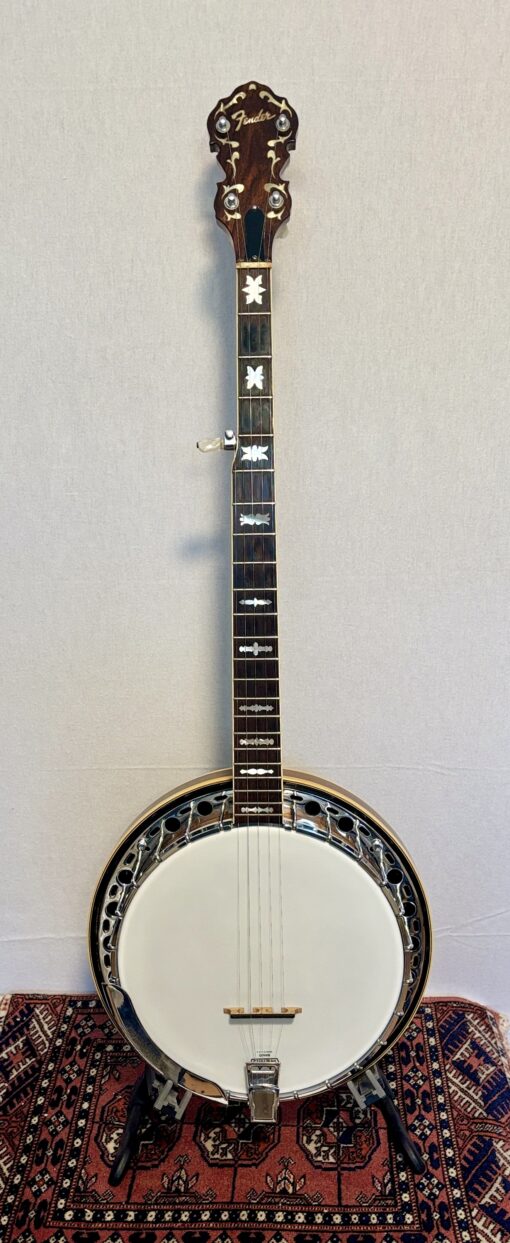
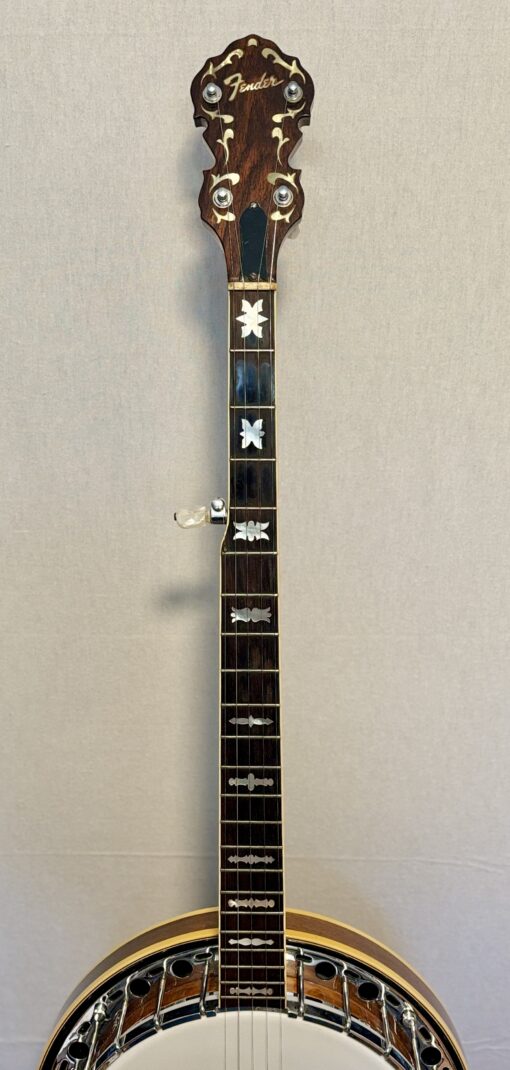
1960s Fender Artist banjo in excellent unplayed condition. Walnut neck and resonator, no-hole flathead tone ring, one-piece flange, pearl bowtie inlays. The same model played by Vic Jordan, Eddie Adcock, and Bill Emerson.
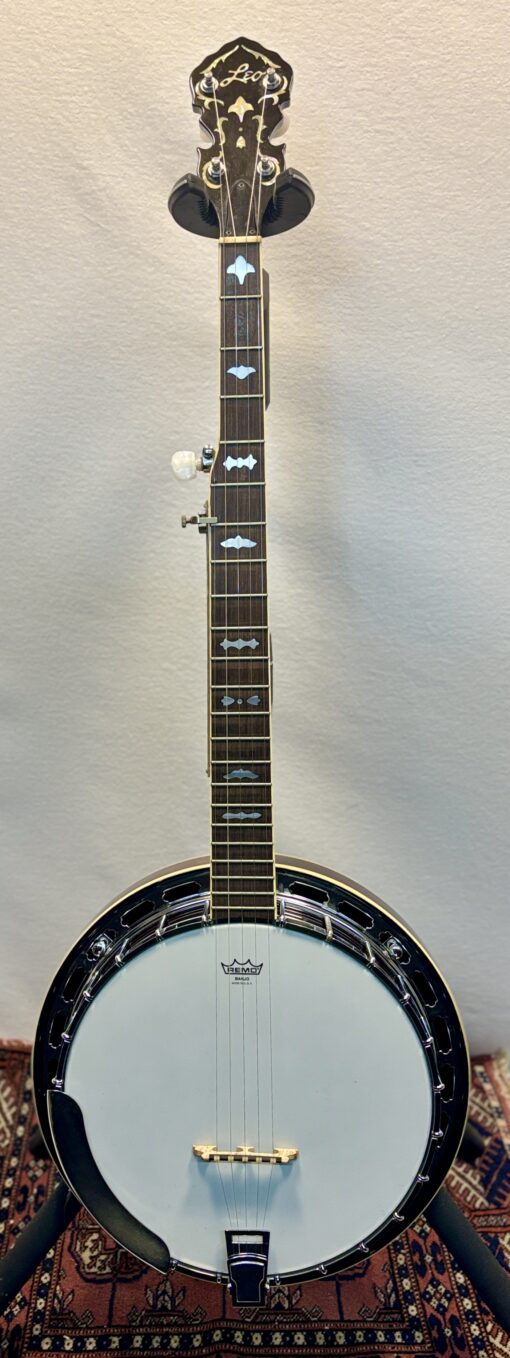
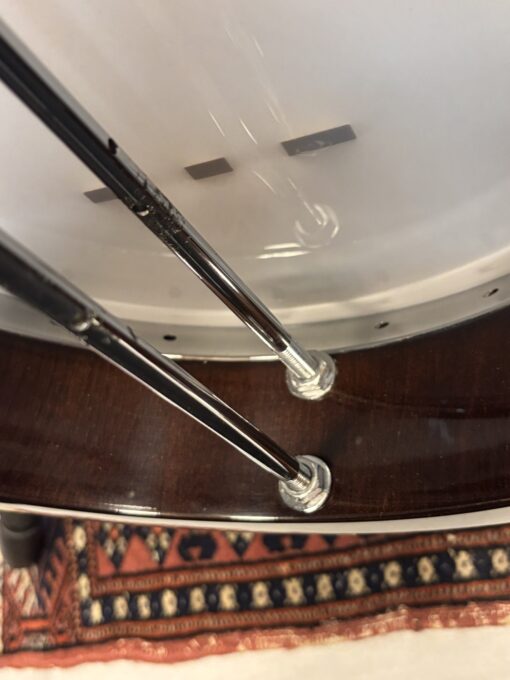
This vintage 1980s Fender Leo banjo was made in Japan to Gibson specs and features a full-size tone ring, 10-ply maple shell, and pro setup. A semi-pro banjo at a beginner price.