Gold Tone vs. Deering: Which Banjo Brand Is Right for You?
By Geoff Hohwald | Banjo Warehouse, Yellow Springs, Ohio
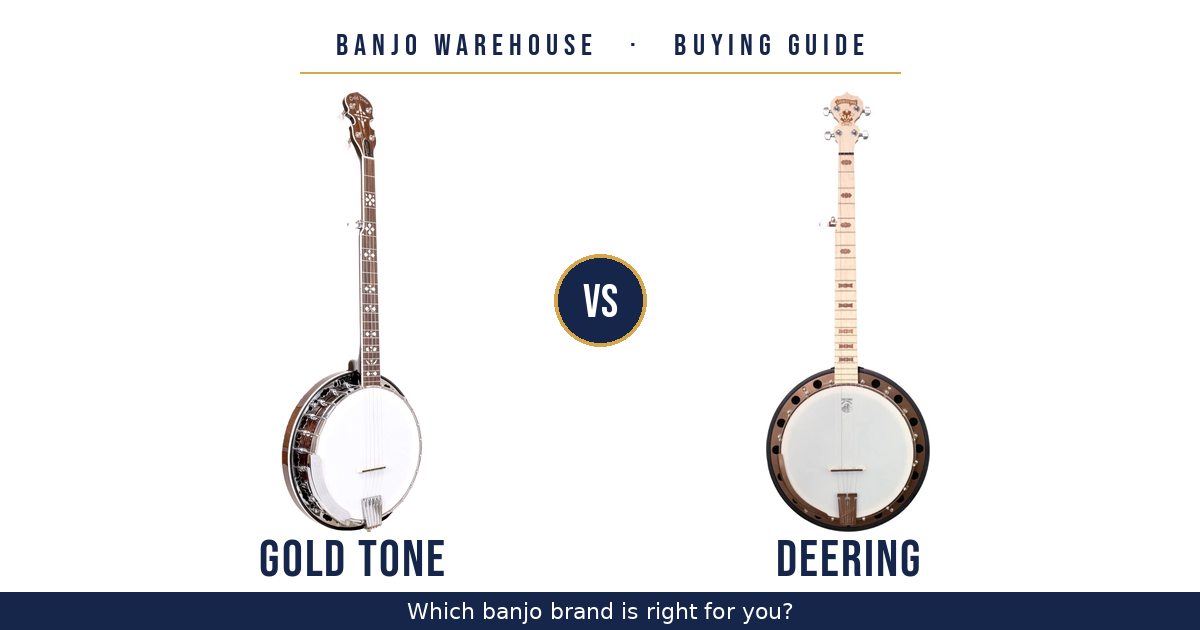
Deering and Gold Tone are the two most popular banjo brands in America today. Deering banjos are American-made in Spring Valley, California, known for consistent factory setups and lifetime craftsmanship. Gold Tone banjos are designed in Titusville, Florida, and offer more features per dollar across a wider range of styles and price points. I’m an authorized dealer for both — here’s my honest take after decades of selling them.
I’ve been selling Deering banjos since the late 1970s and Gold Tone banjos since Wayne Rogers founded the company in the early 1990s. My staff and I answer questions about these two brands almost every single day. So when someone asks me “Deering or Gold Tone?” my answer is always the same: it depends. Not because I’m dodging the question, but because both companies make genuinely excellent instruments and the right choice really does come down to what you’re looking for.
Why My Opinion on This Is Worth Reading
I’ve been playing banjo since 1963 and running music stores since 1980. When I ran Music Mart in Atlanta, I was Deering’s number one dealer in the country in 1980. I visited Deering’s factory on New Year’s Eve in 2025, met the people building the banjos, and shook their hands. I know what goes into those instruments.
On the Gold Tone side, I was an early advocate for Wayne Rogers and his vision for what Gold Tone could become. I interviewed Wayne for the Banjo Newsletter in 2000, an interview Wayne has credited with helping grow the company’s profile. Over the years, I’ve worked directly with Gold Tone to develop several instruments, including the OB-12 Top Tension, the OB-Standard, the OB-2 Bowtie, and the CC-BG beginner package. Every CC-BG package sold includes a link to my Banjo Primer video series.
I also owned the pre-war Gibson banjo that Deering used as the model for the Golden Era, one of the most historically faithful reproductions Deering has ever made.
I say all of this not to brag, but to establish something important: I’m not picking a side here. I have deep relationships with both companies and I want both to succeed. My only interest is in helping you find the right banjo.
What Deering Does Better Than Gold Tone
Deering banjos are made in the USA, in Spring Valley, California. That matters to a lot of players, and it should. These instruments are built by craftspeople who care deeply about what they’re making. When I walked through their factory, I saw beautiful tonewoods, meticulous attention to detail, and a team that takes genuine pride in every banjo that goes out the door.
Look at who plays Deering: Kristin Scott Benson, Tony Trischka, Trae Wellington, Rhiannon Giddens. These are serious musicians who have choices, and they choose Deering. That tells you something.
What I love most about Deering is that their banjos come set up to play. You open the case and it’s ready. The necks are comfortable, the action is right, and the tone is there from day one. They’re also remarkably versatile across styles — from bluegrass to clawhammer to folk and everything in between.
Their Goodtime line is one of the best values in American-made instruments, period. You get real tone at a relatively light weight, at a price that doesn’t require a second mortgage.
One thing I have to be honest about: Deering banjos are hard to get right now. Demand is through the roof, especially for upper-line models. When we have a Deering in stock, I tell people to jump on it. They don’t sit around.
Deering is the call if: you want an American-made instrument, you want a banjo that’s set up properly out of the box, or you’re buying something you plan to play for the rest of your life. See our Deering inventory.
Watch: Geoff plays the Deering Golden Era at the Deering factory in Spring Valley, California.
What Gold Tone Does Better Than Deering
Gold Tone’s entire philosophy is value. Wayne Rogers is a genius when it comes to figuring out how to put professional-grade features into a banjo at a price that working musicians and students can actually afford. By producing at scale and manufacturing in China, Gold Tone can put a heavy-duty banjo with real hardware, real tone rings, and real playability into your hands for significantly less than a comparable American-made instrument would cost.
Bela Fleck, Colton Powers, Bob Carlin, and many others endorse Gold Tone instruments. These aren’t just marketing relationships. These are players who have worked with the company because they believe in what Gold Tone is building.
The addition of Greg Rich as a design consultant has taken Gold Tone’s quality to another level. Greg has designed instruments for Gibson, Rich & Taylor, and Saga, and his work on the OB-12, OB-100, and BG-175F represents some of the most thoughtful banjo design I’ve seen at these price points.
Gold Tone also gives you range. They make beginner banjos, professional banjos, open backs, resonators, 6-strings, electric banjos, and hybrids. Whatever style you play, there’s a Gold Tone built for it.
Gold Tone is the call if: you want maximum features for your dollar, or you’re looking for a specific style or specialty instrument that Deering doesn’t make. See our Gold Tone inventory.
Watch: The Gold Tone OB-Standard in action.
Gold Tone vs. Deering: Side-by-Side Comparison
Where is the banjo made?
Deering banjos are made in the USA in Spring Valley, California. Gold Tone banjos are designed in the USA (Titusville, Florida) and manufactured in China. Neither answer should be a dealbreaker on its own. What matters is what’s in your hands when you open the case.
Which is better for beginners: Gold Tone or Deering?
Either one works well for beginners. If budget is the primary concern, Gold Tone gives you more banjo per dollar. If you want to buy American and want something you’ll still be playing in 20 years, start with a Deering Goodtime.
On the Gold Tone side, the Gold Tone CC-50 at $474.99 is the best new wooden open-back banjo at this price. The CC-50RP at $699.99 adds a removable resonator and planetary tuners. Watch Geoff compare the CC-50 and CC-50RP side by side. The CC-100R at $799.99 steps up further with a rolled brass tone ring and 24 brackets.
On the Deering side, the Deering Goodtime is American-made, virtually indestructible, and comes set up perfectly out of the box. The Goodtime 2 adds a resonator for bluegrass volume. For the price difference, you’re paying for American craftsmanship and a lifetime of durability.
Which is better for bluegrass: Gold Tone or Deering?
Both companies make professional-grade bluegrass banjos. The Deering Golden Era is one of the finest pre-war-style bluegrass banjos made in America today — it was modeled after a banjo I once owned. On the Gold Tone side, the OB-12 Top Tension designed by Greg Rich is a faithful tribute to late-1930s Mastertone construction at a fraction of what a vintage original costs. The OB-3+ with upgraded JLS tone ring is the best-sounding banjo in our showroom at its price point. For pure bluegrass tone, these are different animals — Deering runs warmer, Gold Tone Orange Blossom models run crisper. Neither is wrong.
Which is better for old-time and clawhammer music?
For old-time and clawhammer, open-back construction matters more than brand. Deering’s Goodtime open-back is an excellent clawhammer banjo — lightweight, American-made, and naturally warm. On the Gold Tone side, the CC-50 is the best entry-level wooden open-back we carry, and the OT-800 with its 32-hole tubaphone-style tone ring and scooped ebony fretboard is built specifically for the old-time sound that clawhammer players prize. Deering doesn’t have a direct equivalent to the OT-800 in their lineup. If old-time is your primary style, Gold Tone has more purpose-built options.
Which comes set up better out of the box?
Both companies do a very good job making sure their banjos arrive ready to play. Deering’s factory setup is excellent and consistent across the line. Gold Tone has improved significantly in recent years, particularly with Greg Rich’s involvement in quality control. That said, we stand behind every instrument we sell. Our banjo tech Tara inspects and sets up each banjo we ship from our shop. She trained at the Huber Banjo factory under Steve Huber and Bennie Boling. Whatever brand you buy from us, it’s going to be right when it arrives.
Which has a better warranty: Deering or Gold Tone?
Both brands offer meaningful warranty protection. Deering offers a limited lifetime warranty on all of their instruments — one of the strongest in the industry for American-made banjos. Gold Tone offers a limited lifetime transferable warranty, meaning the warranty transfers to a new owner if you sell the instrument. In practice, both companies have handled warranty issues I’ve seen over the years professionally and fairly. You’re not choosing between warranty coverage here — both stand behind their instruments.
Are Deering banjos worth the extra cost over Gold Tone?
It depends on what you’re buying. At the beginner level, a $599 Deering Goodtime and a $474 Gold Tone CC-50 are both excellent instruments, and the $125 difference is not a meaningful quality gap — it’s largely a made-in-USA premium. At the mid and upper levels, the calculus shifts. A $2,000 Deering is competing with a $1,200 Gold Tone OB-150, and the Deering commands that premium for American labor, tonal refinement, and resale value. At the very top of both lines, you’re comparing instruments in the $3,000–6,000 range and both are serious professional tools. The short answer: Deering’s USA premium is real and justified, but Gold Tone closes the gap faster than most players expect as you move up the price ladder.
Which sounds better?
This is the wrong question. They sound different. Deering banjos tend to have a warm, clear tone with excellent sustain. Gold Tone banjos, particularly the maple Orange Blossom models, can be crisper and snappier. Neither is better. They’re different tools for different sonic goals. If you can, come visit us in Yellow Springs and play both.
Which holds its value better?
Both Deering and Gold Tone retain decent resale value when kept in excellent condition. American-made Deering instruments tend to hold value slightly better on the used market, particularly at the upper end of the line. Gold Tone’s resale is strong at the beginner and mid levels because they’re widely recognized and broadly available. Neither is a bad investment if you take care of it.
My Honest Bottom Line
After more than 40 years of selling both brands, here’s what I tell people: you can’t go wrong with either one. The question is what you’re optimizing for.
If you want American-made craftsmanship and a banjo that’s ready to play the day it arrives, browse our Deering banjos. If you want maximum features and value for your dollar, and access to a wider range of styles and price points, browse our Gold Tone banjos.
Or, honestly? Buy one of each.
Comparing Gold Tone with Recording King instead? Read our Gold Tone vs Recording King comparison.
If you want to talk through your specific situation, call us or stop by the shop in Yellow Springs, Ohio. We’ve been having this conversation with players for decades and we’re happy to have it with you.
Frequently Asked Questions
Is Deering better than Gold Tone?
Neither brand is categorically better. Deering banjos are American-made and set up exceptionally well from the factory. Gold Tone banjos offer more features per dollar and a wider range of models. The right choice depends on your budget, playing style, and what matters most to you in an instrument.
Are Gold Tone banjos made in China?
Gold Tone banjos are designed in Titusville, Florida, and manufactured in China. The company’s quality control has improved significantly in recent years, particularly with the addition of Greg Rich as a design consultant. At Banjo Warehouse, every Gold Tone ships with a professional setup from the Gold Tone factory.
Are Deering banjos worth the price?
Yes. Deering banjos are American-made, set up professionally from the factory, and built to last a lifetime. If you’re buying a banjo you plan to play for decades, a Deering is a sound investment at any price point.
Which banjo brand do professional players use?
Both. Kristin Scott Benson, Tony Trischka, and Rhiannon Giddens play Deering. Bela Fleck, Colton Powers, and Bob Carlin play Gold Tone. Professional players choose based on tone, feel, and style, not brand loyalty.
Which is better for old-time banjo: Gold Tone or Deering?
For old-time music, both brands make capable open-back banjos. Deering’s Goodtime is lightweight, American-made, and well-suited to clawhammer. Gold Tone has a wider range of old-time-specific instruments including the OT-800 Tubaphone, which is purpose-built for the clawhammer sound. If old-time is your primary style, Gold Tone gives you more options at more price points.
Can I try a Deering and Gold Tone banjo before I buy?
Yes. Come visit us at Banjo Warehouse in Yellow Springs, Ohio. We carry both brands and you’re welcome to play them side by side. We’re also happy to answer questions by phone or email if you can’t make the trip.
Does Banjo Warehouse set up banjos before shipping?
Yes. Our used, vintage, and other new instruments are inspected and set up by our banjo tech Tara; every Gold Tone is set up at the Gold Tone factory. Tara trained at the Huber Banjo factory under Steve Huber and Bennie Boling. You won’t receive a banjo from us that isn’t ready to play.
Want to know when new Deering and Gold Tone banjos arrive? Join our email list: Sign up here.
Geoff Hohwald has been playing banjo since 1963 and running music stores since 1980. He is the author of The Banjo Primer (200,000+ copies sold) and the owner of Banjo Warehouse in Yellow Springs, Ohio. He has worked directly with both Deering and Gold Tone for decades and is an authorized dealer for both brands.