
The Deering Goodtime Blackgrass and the Deering Goodtime Blackgrass Special are two American-made bluegrass banjos that share nearly every specification except one: the tone ring. Both feature pure black stain on all-maple wood, matte black powder-coated hardware, a black head, a midnight maple fingerboard with vintage artisan-style pearloid inlays, and the same 3-ply violin grade maple rim. The standard Blackgrass has no tone ring and weighs 6 pounds. The Blackgrass Special features Deering’s patented Goodtime Special steel tone ring and weighs 8.75 pounds. The Blackgrass lists at $1,389. The Blackgrass Special lists at $1,589.
This page covers what’s actually different between the two models, what’s the same, and how to decide which one fits your playing.
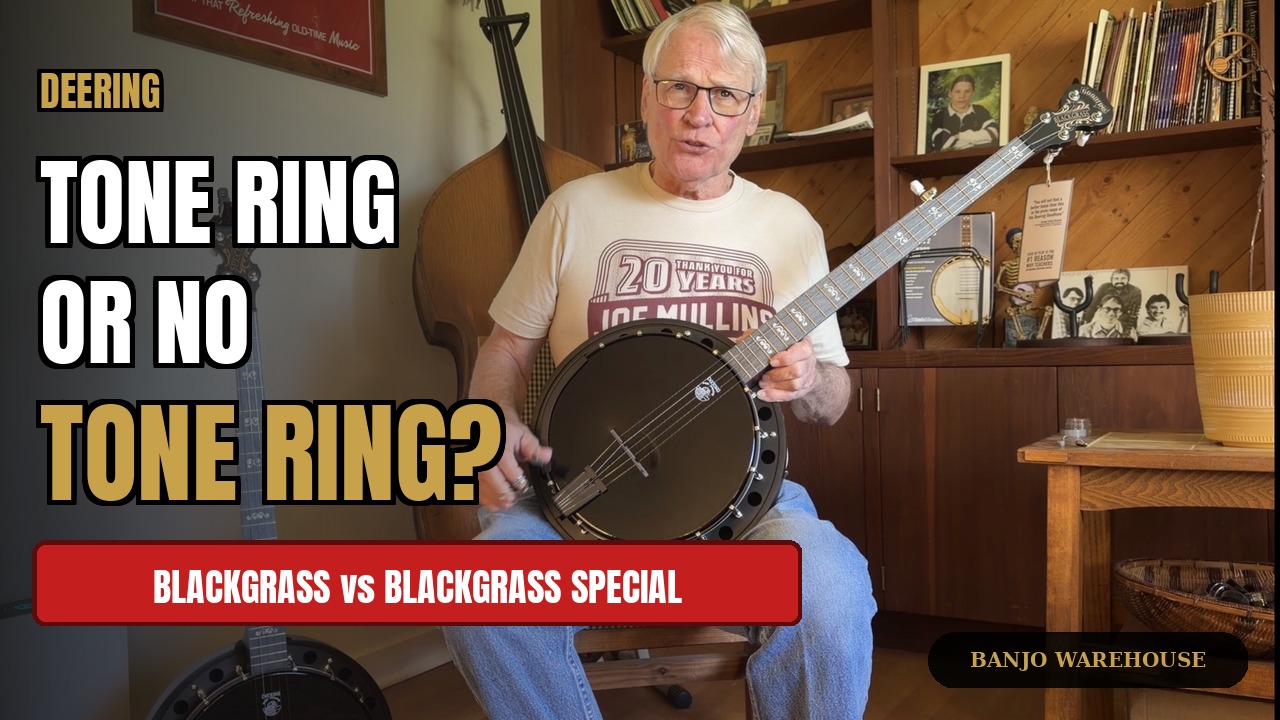
What is the Deering Goodtime Blackgrass?
The Deering Goodtime Blackgrass is an American-made 5-string bluegrass banjo with a pure black aesthetic. It weighs 6 pounds and lists at $1,389. The Blackgrass features a rock maple neck, a 3-ply violin grade maple rim, a midnight maple fingerboard with vintage artisan-style pearloid inlays, and matte black powder-coated hardware throughout. There is no tone ring, which keeps the weight low and produces a tone that sits between an open-back banjo and a tone-ring-equipped resonator banjo: louder and more focused than open-back, but darker and more mellow than a banjo with a steel tone ring.
The Blackgrass is hand-built at Deering’s factory in Spring Valley, California, and ships with spikes installed at frets 7, 9, and 10 so you can play in the keys of A, B, and C right out of the box. Every Blackgrass from Banjo Warehouse receives a professional setup by our banjo tech Tara before shipping.
Watch the Blackgrass and Blackgrass Special compared side by side: watch the full comparison on YouTube or scroll down for the embedded video.
Shop the Deering Goodtime Blackgrass at Banjo Warehouse.
What is the Deering Goodtime Blackgrass Special?
The Deering Goodtime Blackgrass Special is the tone-ring version of the standard Blackgrass. It weighs 8.75 pounds and lists at $1,589. The Special features Deering’s patented Goodtime Special steel tone ring sitting on top of the same 3-ply violin grade maple rim used on the standard Blackgrass. The steel tone ring produces a brighter, richer, more authoritative bluegrass tone with significantly more sustain and projection than the standard Blackgrass.
Every other specification is identical to the standard Blackgrass: same rock maple neck, same midnight maple fingerboard with vintage artisan-style pearloid inlays, same matte black powder-coated hardware, same black resonator, same satin black finish, same Goodtime planetary tuners, same Goodtime geared 5th string tuner.
Shop the Deering Goodtime Blackgrass Special at Banjo Warehouse.
Blackgrass vs Blackgrass Special Specification Comparison
| Specification | Blackgrass | Blackgrass Special |
|---|---|---|
| Price | $1,389 | $1,589 |
| Weight | 6 lbs | 8.75 lbs |
| Tone ring | None | Patented Goodtime Special Steel Tone Ring |
| Rim | 11″ 3-ply violin grade maple | 11″ 3-ply violin grade maple |
| Neck wood | Rock maple | Rock maple |
| Neck shape | Slender “D” shape | Slender “D” shape |
| Fingerboard | Midnight maple | Midnight maple |
| Inlays | Vintage artisan-style pearloid | Vintage artisan-style pearloid |
| Frets | 22 pressed-in nickel silver | 22 pressed-in nickel silver |
| Nut | 1 1/4″ Lexan Polycarbonate | 1 1/4″ Lexan Polycarbonate |
| Tuners | Goodtime planetary | Goodtime planetary |
| 5th string tuner | Goodtime geared | Goodtime geared |
| Head | 11″ Black High Crown | 11″ Black High Crown |
| Tension hoop | Beveled steel | Beveled steel |
| Hooks | 16 flat J-hooks, 9/32″ hex nuts | 16 flat J-hooks, 9/32″ hex nuts |
| Flange | Two-piece Goodtime series | Two-piece Goodtime series |
| Bridge | 5/8″ Goodtime Smile bridge | 5/8″ Goodtime Smile bridge |
| Tailpiece | Patented Goodtime | Patented Goodtime |
| Hardware finish | Matte black powder | Matte black powder |
| Resonator | 13 7/8″ 3-ply poplar/poplar/maple | 13 7/8″ 3-ply poplar/poplar/maple |
| Resonator stain | Black | Black |
| Finish | Hand-finished satin polyurethane | Hand-finished satin polyurethane |
| Scale length | 26 1/4″ | 26 1/4″ |
| Tuning | GDGBD | GDGBD |
| Spikes installed | 7, 9, 10 | 7, 9, 10 |
| Warranty | 8-year limited | 8-year limited |
| Made in | USA (Spring Valley, CA) | USA (Spring Valley, CA) |
| Left-handed available | Yes | Yes |
Watch the Blackgrass vs Blackgrass Special Comparison
Geoff demos both banjos side by side so you can hear the tone difference.
What’s the difference between the Blackgrass and Blackgrass Special?
Two specifications differ between the two banjos:
Tone ring
The standard Blackgrass has no tone ring. The head sits directly on the wooden 3-ply violin grade maple rim, which produces a tone that’s clear and bright but with the warm woody character of a no-tone-ring banjo. The sound is louder and more focused than an open-back banjo (because of the resonator and flange) but darker and more mellow than a banjo with a steel tone ring.
The Blackgrass Special features the patented Goodtime Special steel tone ring, sitting on top of the same wooden rim. The steel ring produces a brighter, richer tone with noticeably more sustain and projection. Deering describes it as producing “a louder, sweeter bell tone” with “good volume, clarity of tone, and the sparkling sound found in banjos at three times the price.”
If you want the traditional bluegrass cut and projection that defines the Earl Scruggs sound, the steel tone ring on the Blackgrass Special is what you want. If you prefer a darker, more mellow tone closer to old-time playing, or you want the lighter weight of a banjo without a tone ring, the standard Blackgrass is the right choice.
Weight
The Blackgrass weighs 6 pounds. The Blackgrass Special weighs 8.75 pounds. That’s a 2.75-pound difference, almost entirely from the steel tone ring.
For most players, 2.75 pounds doesn’t seem like much in isolation. But banjo weight is felt across hours of playing, especially during long gigs played standing up or during travel. The lighter Blackgrass is significantly more comfortable for extended sessions, and considerably easier to take to jams, lessons, or shows. The heavier Blackgrass Special trades that comfort for the tonal authority of the steel ring.
What’s the same between the Blackgrass and Blackgrass Special?
The two banjos share their neck, hardware, finish, and aesthetic specifications:
- Same 3-ply violin grade maple rim
- Same 11″ rim diameter
- Same rock maple neck with slender “D” shape
- Same satin black stain on all maple wood
- Same midnight maple fingerboard
- Same vintage artisan-style pearloid inlays
- Same 22 pressed-in nickel silver frets
- Same 1 1/4″ Lexan Polycarbonate nut
- Same Goodtime planetary tuners
- Same Goodtime geared 5th string tuner
- Same 11″ Black High Crown head
- Same beveled steel tension hoop
- Same 16 flat J-hooks with 9/32″ hex nuts
- Same two-piece Goodtime series flange
- Same Goodtime armrest
- Same matte black powder-coated hardware
- Same 5/8″ Goodtime Smile bridge
- Same patented Goodtime tailpiece
- Same hand-finished satin polyurethane
- Same 3-ply poplar/poplar/maple resonator
- Same 13 7/8″ resonator diameter
- Same satin black resonator stain
- Same 26 1/4″ scale length
- Same 38″ overall instrument length
- Same GDGBD tuning
- Same spike installation at frets 7, 9, and 10
- Same 8-year limited warranty
- Same Spring Valley, California construction
This means both banjos play the same, feel the same, and look almost identical. The differences are entirely in what you hear when you strike the strings and what you feel when you carry the instrument.
Which one sounds better?
Neither one is objectively better. They sound different, and the right answer depends on what kind of bluegrass tone you want.
The standard Blackgrass sounds darker and more mellow. Players who enjoy the wooden character of a no-tone-ring banjo, who play at home or in small acoustic settings, or who play old-time as well as bluegrass will hear more of what they want from the Blackgrass.
The Blackgrass Special sounds brighter, louder, and more authoritative. Players who want the traditional Earl Scruggs cut, who play in bluegrass jams or onstage with other amplified instruments, or who want maximum projection from their banjo will hear more of what they want from the Special.
The patented Goodtime Special steel tone ring is genuinely good. Deering’s claim that it produces “the sparkling sound found in banjos at three times the price” is fair. If you’ve played higher-tier Deering models with their bell brass tone rings, the Special doesn’t reach those tonal heights, but it gets surprisingly close for the price.
Which one is better for beginners?
Either banjo works well for beginners. Both ship with professional setup, both have spikes installed, both come in left-handed versions, and both have the 8-year Deering warranty.
If a beginner is unsure whether they’ll stick with banjo, the standard Blackgrass at $1,389 is the lower-risk choice and the lighter weight makes long practice sessions easier on the body. If a beginner already knows they want the bluegrass sound and is committed to the instrument, the Blackgrass Special’s steel tone ring delivers a more rewarding tone from day one and is the better long-term value.
The $200 price difference between the two is small enough that the choice should be made on tone preference, not budget.
Which one is better for stage and gigging?
The Blackgrass Special is the better stage banjo. The steel tone ring’s projection and cut are designed for exactly this situation, where you need your banjo to be heard alongside other instruments without amplification.
The standard Blackgrass at 6 pounds is significantly more comfortable for long standing sets, but for most bluegrass players the tonal advantage of the Special outweighs the weight penalty in stage settings. If you play many shows, gig regularly, or perform in jams with mandolin and guitar players, the Special is the right choice.
If you primarily travel with your banjo, play at smaller acoustic venues, or carry your instrument on flights, the Blackgrass at 6 pounds is dramatically easier to live with than nearly any other resonator banjo on the market.
How do the Blackgrass and Blackgrass Special compare to other Deering Goodtime models?
The Blackgrass and Blackgrass Special sit in Deering’s Goodtime series, which is the entry tier of Deering’s American-made banjo lineup. The Goodtime line is hand-built at Deering’s Spring Valley, California factory using the same craftsmanship that goes into Deering’s higher-tier banjos, but with simpler appointments to keep the price accessible.
Players considering a step up from the Blackgrass Special should look at the Deering Artisan Goodtime Special at $1,799, which features a similar steel tone ring with upgraded fingerboard appointments and a more refined finish. Above the Goodtime tier, Deering’s Sierra and Boston models bring in cast bronze tone rings and bell brass tone rings respectively, with prices starting around $2,400 and climbing into the $5,000-plus range for the John Hartford and Calico models.
For players coming up from a beginner banjo, the Blackgrass and Blackgrass Special are both meaningful upgrades from the lower-tier Goodtime Two and represent the most distinctive aesthetic in the Deering lineup. No other Deering model has the all-black finish.
Where to buy the Deering Blackgrass and Blackgrass Special
Banjo Warehouse is an authorized Deering dealer based in Yellow Springs, Ohio. Both the Blackgrass and Blackgrass Special are available through us with:
- Professional setup by our banjo tech Tara before shipping
- Free US shipping
- 7-day money-back guarantee
- Spikes installed at frets 7, 9, and 10
- 8-year Deering limited warranty
- PayPal Pay in 4 financing on all orders
- Afterpay financing available (4 interest-free installments, or 3, 6, 12, or 24 month plans)
Both models are available in left-handed configurations.
Shop both banjos at Banjo Warehouse:
To order or ask questions, call Geoff at (404) 218-8580 or email thebanjowarehouse@gmail.com.
Frequently Asked Questions
What’s the only difference between the Deering Blackgrass and Blackgrass Special?
The only meaningful difference is the tone ring. The standard Blackgrass has no tone ring. The Blackgrass Special features Deering’s patented Goodtime Special steel tone ring. The steel tone ring produces a brighter, louder, more sustained tone and adds 2.75 pounds to the instrument’s weight.
How much does the Deering Blackgrass weigh?
The standard Deering Goodtime Blackgrass weighs approximately 6 pounds. The Deering Goodtime Blackgrass Special weighs approximately 8.75 pounds. The 2.75-pound difference is almost entirely the steel tone ring.
Is the Deering Blackgrass Special worth the extra $200?
For most bluegrass players, yes. The Goodtime Special steel tone ring meaningfully changes the sound of the banjo, producing a brighter, more projective bluegrass tone that’s closer to the traditional Earl Scruggs sound. For old-time players or players who prefer a darker, more mellow tone, the standard Blackgrass at $1,389 is the better choice.
Are the Deering Blackgrass and Blackgrass Special made in the USA?
Yes. Both banjos are hand-built at Deering’s factory in Spring Valley, California, the same factory that builds every Deering banjo from the entry-level Goodtime Two to the flagship Calico.
Is the Deering Blackgrass available left-handed?
Yes. Both the Blackgrass and Blackgrass Special are available in left-handed versions through Banjo Warehouse. Left-handed versions are typically built to order and may have slightly longer lead times.
Does the Deering Blackgrass come with a case?
Both banjos ship with a Deering padded gig bag included. A hardshell case is available separately.
What’s the warranty on the Deering Blackgrass?
Both the Blackgrass and Blackgrass Special carry an 8-year Deering limited warranty covering materials and workmanship. Banjo Warehouse handles warranty claims directly with Deering on behalf of customers.
Want to know when new banjos arrive?
Join our email list: https://f02c7f60b02f11ef81a461960b153e18.eo.page/9n1z3
About Banjo Warehouse
Banjo Warehouse has been selling fine banjos since 1980, now based in Yellow Springs, Ohio. Owner Geoff Hohwald has been playing and selling banjos since 1963. Geoff is the author of The Banjo Primer, with over 200,000 copies sold. Get The Banjo Primer on Amazon: https://amzn.to/4s0G9Rj
Banjo Warehouse is an authorized Deering dealer and an authorized Gold Tone dealer.