How Much Should I Spend on My First Banjo?
By Geoff Hohwald | Banjo Warehouse, Yellow Springs, Ohio | Updated April 2026
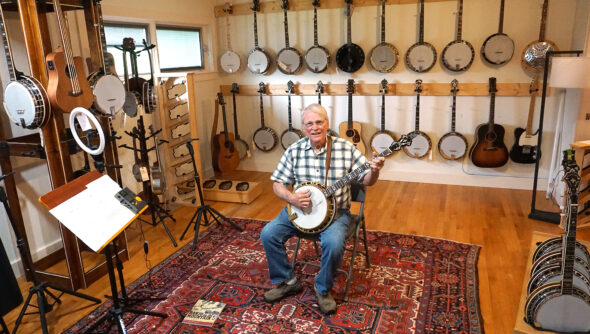
I’ve been selling banjos since 1980. This is the question I get more than almost any other. And the honest answer is: it depends on your budget. But I can give you a clear picture of what you get at every price point, so you can make the right call for your situation.
Before we get to price, there’s something more important to understand: something that trips up more first-time buyers than anything else. It has nothing to do with how much you spend. It has to do with setup.
Why Setup Matters More Than Price
Buying your first banjo can be confusing, particularly if you live in an area that doesn’t have a store with someone who actually knows banjos. And that’s most areas.
Here’s why it matters so much: a banjo has between 40 and 60 parts depending on the model. Every single one of those parts has the potential to buzz or cause problems. On top of that, the banjo has an adjustable head, a drum head stretched across the pot, that will shift over time, especially during shipping and as the instrument acclimates to a new environment. When the head goes out of adjustment, the banjo sounds dull, buzzy, or just wrong. Most beginners assume it’s their playing. It isn’t.
There’s also an older neck adjustment system that has been used in banjos for almost 50 years that simply doesn’t work reliably. By luck of the draw you may find one of these that plays great right out of the box. But if it ever goes out of adjustment, and it will, getting it back in spec is time-consuming and expensive. Many of these banjos leave the factory overseas in perfect adjustment and arrive at a warehouse or at your door out of adjustment due to shipping and settling. You’ll never know if that’s what happened, and you’ll spend months thinking you’re the problem.
The other issue is that many beginners buy a banjo that doesn’t function properly and conclude they lack ability when the real problem is the instrument. A bad setup is one of the most common reasons people quit the banjo.
So how do you protect yourself?
Buy from a dealer who can inspect and set up the instrument before it reaches you. Every banjo we sell ships professionally set up: used and vintage banjos in-house by our tech Tara, new Gold Tones at the Gold Tone factory. Tara trained at the Huber Banjo factory under Steve Huber and Bennie Boling. You will not receive an unplayable banjo from us.
Watch: Tara walks through banjo cleaning and setup, the same process she uses on every instrument we set up here.
What about pawn shops and cheap online listings?
Most cheap banjos from pawn shops don’t play properly. The challenge isn’t just finding one that works: it’s finding someone who can fix it if it doesn’t. In most parts of the country, that person doesn’t exist locally. And the cheapest banjos on Amazon aren’t set up at all. They won’t stay in tune, and they make learning far harder than it needs to be.
A smarter way to think about cost
Most first-time buyers think of the cost of a banjo as the price they pay for it. A better way to think about it is the difference between what you paid and what you were able to sell or trade it for later.
Here’s an example: you find a banjo that sells new for $2,500. The previous owner barely played it, so you buy it in excellent condition for $1,500. You play it for three years and sell it for $1,100. You’ve used a great instrument for three years at a total cost of $400, about $11 a month.
Compare that to buying a $500 banjo with no resale value that doesn’t play well and causes you to quit after six months. The more expensive banjo is actually the better investment, and gives you a much better chance of success.
That said, we have options at every price point and we’ll help you find the right one for your situation. We also frequently have used instruments available at lower prices. Contact us to ask what’s in stock.
The Price-by-Price Breakdown
Everything listed below is a new banjo with a manufacturer warranty unless noted otherwise. We offer financing through PayPal Pay in 4 on all orders and Afterpay on instruments under $4,000.
$314.99 – Gold Tone AC-1: The Lightest Possible Entry Point
The Gold Tone AC-1 is the least expensive banjo we sell online, and it’s a legitimate instrument. It’s a composite rim open-back 5-string, lighter than almost anything else on the market at under 4 pounds, and it won Best in Show at NAMM. If your budget is around $300 and you want to start playing today, this is your banjo.
Used AC-1s come through from time to time. Contact us to ask.
Watch: Geoff plays the AC-1 at the Gold Tone facility in Titusville, Florida. He pulls a lot of tone out of it.
$474.99 – Gold Tone CC-50: The Cheapest New Wooden Banjo We Recommend
The Gold Tone CC-50 is a solid open-back 5-string with a multi-ply maple rim, rolled brass flat bar tone ring, two-way adjustable truss rod, 18 brackets, single coordinator rod, and guitar-style tuners. No-frills and well-built at this price. It’s worth noting that the CC-50 has the same rolled brass tone ring as the CC-100R: the distinction between these two instruments is in the rest of the package, not the tone ring.
$499.99 – Gold Tone AC-5: The Lightest Resonator Option
If you want a resonator banjo, more volume, brighter bluegrass sound, but aren’t quite ready to spend $700, the Gold Tone AC-5 is worth a look. Composite rim and resonator, same weight as an open-back at 5.5 lbs, and easy to play. The most travel-friendly resonator banjo we carry.
$599 – Deering Goodtime: The Best American-Made Banjo at This Price
The Deering Goodtime is one of the most iconic beginner banjos ever made. Built in Spring Valley, California. Virtually indestructible. Real tone from a 3-ply maple rim. If you want something wooden, American-made, and genuinely beautiful to look at, save up for a Goodtime. It will hold its value, and it’s comfortable enough to play for life.
Watch: The Deering Goodtime in action.
$699.99 – Gold Tone CC-50RP: Resonator with Planetary Tuners
The Gold Tone CC-50RP adds a full-walled removable resonator and GT planetary tuners to the CC-50 platform. Same maple rim and rolled brass tone ring as the CC-50, but with the volume and projection you need for bluegrass. The resonator pops off easily for open-back playing: one banjo, two styles.
$699.99 – Gold Tone CC-BG: The Best Beginner Package We Offer
The Gold Tone CC-BG is our recommended beginner resonator package. Every CC-BG sold includes a link to my Banjo Primer video series: instrument and instruction together. If you’re a true beginner who wants everything in one place, this is where I’d point you.
$799.99 – Gold Tone CC-100R or Recording King RKR-20: More Features, More Hardware
The Gold Tone CC-100R shares the same rolled brass flat bar tone ring as the CC-50, but steps up significantly everywhere else: a convertible resonator you can remove for open-back playing, 24 brackets vs 18, dual coordinator rods vs single, and GT planetary tuners vs sealed guitar-style tuners. It also weighs one pound more at 6.5 lbs. The result is a more complete, more stable, more versatile bluegrass setup. If you want a resonator banjo with a full hardware package, this is the entry point. The Recording King RKR-20 is similarly spec’d and well regarded at this price. Contact us about the RKR-20.
Watch: The Gold Tone CC-100R in action.
$849 – Deering Goodtime 2: The Goodtime with a Resonator
The Deering Goodtime 2 takes everything that makes the Goodtime great and adds a resonator for more volume and projection. If you know you want bluegrass and you want American-made, this is the one to save up for.
$899.99 – Gold Tone HM-25: The Clawhammer and Old-Time Pick
The newest of Gold Tone’s High Moon open-backs: a scooped-fingerboard banjo built for the clawhammer down-stroke, with a wood tone rim for that warm, dry old-time voice. 6.5 pounds with a padded gig bag included. Watch the HM-25 demo, or see all my old-time picks in the best clawhammer banjos guide.
$999.99 – Gold Tone BG-150F or BG-175F: Gibson-Inspired at an Accessible Price
This is where things start to get serious. The Gold Tone BG-175F and BG-150F feature Hearts and Flowers inlays, rolled brass tone rings, multi-ply maple rims, and the look of a Gibson at a fraction of the price. The BG-175F was designed by Greg Rich. To be precise about construction: these banjos have tone hoops rather than full weight tone rings, which puts them in similar structural territory to the Recording King RKR-20 at the price point just below. The cosmetics and playability are exceptional for the price. If you want something that looks like a Gibson and plays like a real bluegrass banjo, this is your price point.
Watch: Gold Tone’s Dale Parker plays the BG-175F.
Used BG-150F and BG-175F banjos come through from time to time. Ask us what’s available.
Best Banjo Under $300?
Yes, if it’s the right $300 banjo. The Gold Tone AC-1 at $314.99 is a legitimate instrument that won Best in Show at NAMM. What you want to avoid is the cheapest options on Amazon, which aren’t set up and won’t stay in tune. Every banjo we sell is professionally set up before it ships.
Our full honest answer: best banjo under $300 →
Best Banjo Under $500
The Gold Tone AC-1 ($314.99), Gold Tone CC-50 ($474.99), and Gold Tone AC-5 ($499.99) are all strong choices. The AC-1 is the lightest and most affordable. The CC-50 is the best wooden open-back at this price. The AC-5 gives you a resonator for more volume.
See where these rank in our best banjos under $1,000 →
Best Banjo Under $1,000
The Deering Goodtime ($599) for American-made quality, or the Gold Tone CC-100R ($799.99) if you want more features and a brass tone ring. The Deering Goodtime 2 ($849) adds a resonator and is an exceptional value.
The full ranked list: best banjos under $1,000 →
Browse all banjos under $999 →
Above $1,000: Full Weight Tone Rings and Professional Territory
Once you cross $1,000, you’re moving into full weight tone ring territory, where the banjo starts to sound like what you hear on professional recordings. The BG-150F and BG-175F at $999.99 have tone hoops and are excellent instruments, but the construction below and above this line is meaningfully different. Appropriate for serious beginners, intermediate players, and professionals alike.
$1,049.99 – Vintage Fender Leo: Japanese-Made and Underrated
The Fender Leo is a vintage Japanese-made banjo that offers exceptional value. History, a full tone ring, and a price that won’t break the bank. We don’t always have these in stock: when we do, move fast.
$1,099.99 – Gold Tone OB-100: A Tone Hoop Modeled After the RB-100
The Gold Tone OB-100 is a lightweight Orange Blossom tribute to the legendary RB-100. Rolled brass tone ring, one-piece flange, classic styling. Just 13 lbs. A Greg Rich design. Serious instrument at a serious but accessible price.
Watch: Dale Perry of Fast Track plays the Gold Tone OB-100.
$1,229 – Deering Goodtime 2 Special
A step up from the Goodtime 2 with a tone ring for more power and projection. We don’t always have these in stock. Contact us to ask about availability.
$1,299.99 – Gold Tone OB-150: The Affordable Pro Bluegrass Banjo
One of the best values in professional-grade bluegrass banjos. The Gold Tone OB-150 has a three-ply Canadian maple rim, one-piece cast flange, and 20-hole flat top bell brass tone ring machined to pre-war specs. This is where Mastertone-level construction begins in the Gold Tone lineup. Hardshell case included.
$1,449.99 – Recording King RKR-35
The Recording King RKR-35 is one of the most highly regarded banjos in its price range anywhere. Tone ring designed on the pre-war Gibson flathead. Consistently recommended by serious players. One important note: Recording King no longer exists as a company. Their quality control was hit or miss toward the end of the brand’s run, so if you’re buying one, new or used, make sure it has been properly set up before it reaches you, or that you have a trusted banjo tech who can evaluate and set it up. The Aria Pro II ($1,549.99) is a vintage Japanese instrument that punches well above its price in tone and craftsmanship. Both are exceptional values when properly set up.
$1,589 – Deering Goodtime Blackgrass Special
The Deering Goodtime Blackgrass Special is the Goodtime with a tone ring and an all-black finish. American-made, powerful, distinctive. For a player who wants Deering build quality with professional tone.
$1,599 – Deering Artisan Goodtime Special
The Deering Artisan Goodtime Special is the top of the Goodtime line. American-made with a tone ring, upgraded aesthetics, and the same comfortable Deering neck profile the line is known for. A professional instrument with a lifetime of playability.
A Few Things Worth Knowing
Should I buy used?
Absolutely. We frequently have used versions of many of the instruments on this list at lower prices than new. A used Goodtime, CC-100R, or OB-150 in good condition is an exceptional value. Contact us or check our current inventory to see what we have.
What about financing?
We offer PayPal Pay in 4 on all orders and Afterpay on instruments under $4,000, with options for 3, 6, 12, or 24 month payment plans with no late fees. Don’t let price stop you from getting the right instrument.
What about cheap banjos on Amazon?
Steer clear. They aren’t set up, they won’t stay in tune, and they make learning harder than it needs to be. A bad first instrument is one of the most common reasons people quit. Every banjo we sell ships professionally set up.
Does my banjo come set up and ready to play?
Every banjo we sell ships professionally set up. Tara trained at the Huber Banjo factory under Steve Huber and Bennie Boling. Whatever you order from us will be ready to play when it arrives.
Frequently Asked Questions
How much should a beginner spend on a banjo?
We recommend starting at $314.99 for the Gold Tone AC-1 at the minimum. If you can stretch to $599, the Deering Goodtime is one of the finest beginner banjos ever made. If you want a resonator at an entry price, the Gold Tone AC-5 at $499.99 is a solid choice. Your budget determines your starting point, but any instrument on this list will give you a legitimate banjo experience.
Why does setup matter so much on a banjo?
A banjo has 40 to 60 parts, any of which can cause buzzing or tuning problems. The head is adjustable and shifts over time, especially during shipping. An improperly set up banjo will sound bad regardless of its price, and most beginners blame themselves when the instrument is the actual problem. Every banjo we sell ships professionally set up.
Do you have used banjos for sale?
Yes. We frequently have used versions of many instruments on this list. Contact us or browse our current inventory to see what’s available.
We knew this article would generate conversation and we actively encourage it. The banjo community is full of knowledgeable players who have strong opinions, and that’s a good thing. If you have thoughts, corrections, or additions, we welcome them.
A Note of Thanks to the Banjo Hangout and Reddit Communities
Shortly after this guide was published, members of both the Banjo Hangout and Reddit communities offered thoughtful corrections and additions. We want to address them directly.
Ken Norkin (Old Hickory) on Banjo Hangout made an accurate and important point: the BG-150F and BG-175F are not correctly described as “Mastertone-style” banjos in the traditional sense. Gibson historically reserved the Mastertone designation for banjos with full weight tone rings and one or two-piece flanges. The BG-150F and BG-175F have tone hoops and non-structural flange plates, structurally similar to the Recording King RKR-20 at the price point just below them. We’ve updated the guide to reflect this accurately. Ken is right that Gold Tone’s Mastertone-level construction genuinely begins at the OB-150. His comment also correctly notes that Gold Tone now holds the Mastertone trademark.
Graham Hawker made fair points about the used market and the availability of quality banjos at lower price points, particularly in the UK. He is correct that bargains exist if you know what you’re looking for. Our guidance about avoiding cheap Amazon banjos is aimed at beginners who don’t yet have the experience to evaluate what they’re buying, not at experienced players who can spot a good deal. If you know banjos well enough to evaluate a used instrument, the used market is absolutely worth exploring. One caveat worth adding: Japanese and Korean Mastertone-style banjos that come up at lower prices can be nightmarish to set up. Some use coordinator rod systems and other hardware that requires specialized knowledge to adjust properly. Unless you have a trusted banjo tech in your area who has worked on these instruments before, be careful. A bargain that sits unplayable in the corner isn’t a bargain.
On Reddit, several players reinforced the core principle of this guide. One commenter put it well: buy as much banjo as you can afford. A better instrument has higher resale value and will make you want to practice more because it’s genuinely fun to play. Another commenter noted that $500 in the used market got them a Recording King RKR-20 in like-new condition, a legitimate outcome for a buyer who knows what they’re looking for. The suggestion to look up Tom Collins’ take on choosing a banjo is also worth your time for anyone considering higher-end instruments.
Thank you to everyone who engaged with this guide seriously. This is exactly the kind of community expertise that makes Banjo Hangout and r/banjo two of the best resources for banjo players anywhere.
– Geoff Hohwald, Banjo Warehouse
Want to know when new banjos arrive? Join our email list: Sign up here.
Geoff Hohwald has been playing banjo since 1963 and running music stores since 1980. He is the author of The Banjo Primer (200,000+ copies sold) and the owner of Banjo Warehouse in Yellow Springs, Ohio.