
Banjo Setup & Maintenance
What Makes a Parts Banjo? Inside This Reissue Gold Star GF-85 Build
Mar
A parts banjo is one of the most misunderstood instruments in bluegrass. The name sounds like a compromise — something cobbled together from whatever was available. In practice, a well-built parts banjo can outperform instruments costing twice as much. Here’s what that looks like in practice, using a Gold Star GF-85 style instrument that came through our shop as the example.
What Is a Parts Banjo?
A parts banjo is an instrument assembled from components sourced separately rather than built as a complete unit by a single manufacturer. The neck might come from one source, the pot from another, the tone ring from a third. The logic is straightforward: take the best parts available at a given price point and combine them into something that no single manufacturer would ship as a complete instrument at that cost.
The quality of a parts banjo depends entirely on the quality of the decisions made in assembling it. A poorly chosen combination of parts produces a poor instrument. A well-chosen combination — the right rim, the right tone ring, components that work together rather than against each other — can produce something genuinely special.
What Is the Gold Star GF-85?
The original Gold Star GF-85 was produced in Japan starting in the late 1970s, built as a close copy of the 1930s Gibson RB-75. The RB-75 was a mahogany-body banjo with leaves and bows inlay — the same design that J.D. Crowe’s banjo was based on. When Gold Star introduced reissue GF-85 models at the 2004 NAMM show, they used new tooling built to original Gibson specifications: genuine 13 5/8″ resonator diameter, nitrocellulose lacquer, dual coordinator rods, bone nut, and a one-piece flange faithful to the 1929 Gibson subcontractor blueprint.
The GF-85 has a devoted following among players who want the mahogany aesthetic and the leaves and bows inlay without paying Gibson Mastertone prices. The neck and resonator on these instruments are genuinely well made. The pot — the rim and tone ring assembly — is where a builder can make meaningful upgrades.
How This Particular Instrument Was Built
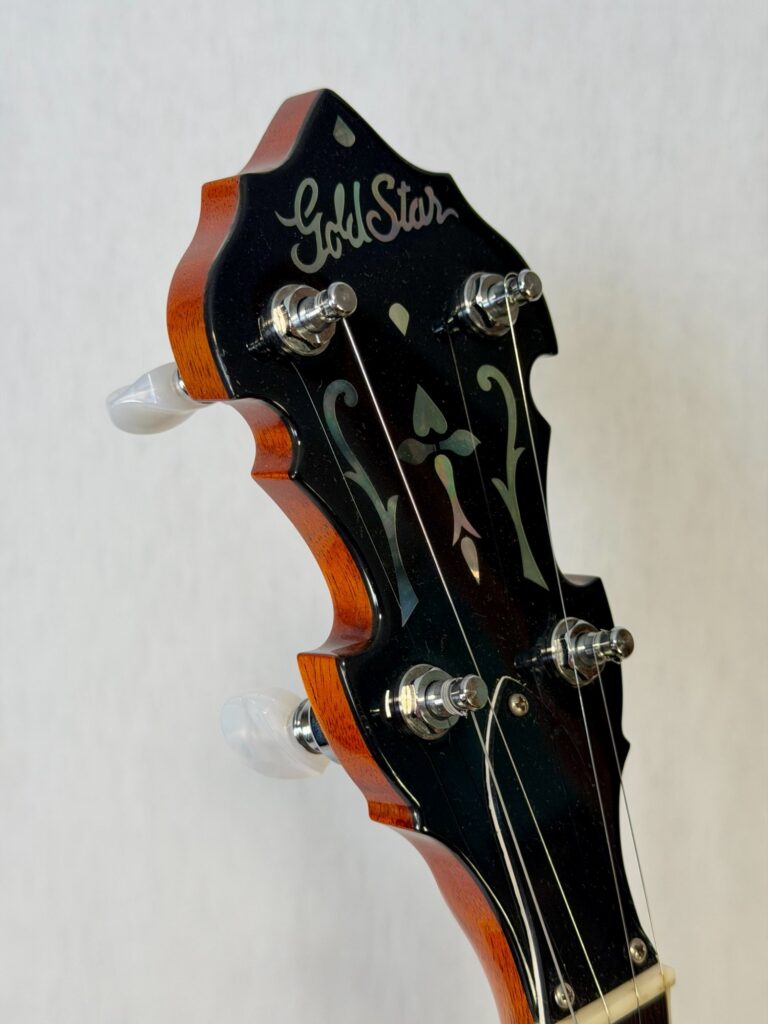
The GF-85 style instrument we used as our example had an original Gold Star reissue neck — mahogany, bound rosewood fingerboard, the GF-85 leaves and bows mother-of-pearl inlay pattern based on Crowe’s RB-75. The resonator was also original Gold Star, a 13 5/8″ mahogany bowl with cream binding top and bottom that matches the GF-85 spec. The one-piece flange, armrest, and hardware were all original.
What changed was the pot. Whoever built this up did it right. They installed an American-made hard rock maple rim and paired it with an archtop 40-hole tone ring. The tailpiece was a Kershner.
Geoff played it for the first time when we were shooting the video. His reaction: “a fantastic banjo for really not that much money.” He added that it “peels the paint off the walls.”
Why Hard Rock Maple Changes the Sound
The standard Gold Star GF-85 uses a mahogany pot. Mahogany is a warm, somewhat porous wood that produces a round, full tone. Hard rock maple is denser and stiffer. It transmits more energy to the tone ring instead of absorbing it, which adds volume and focus.
Paired with an archtop tone ring — which contacts the head from beneath with a curved surface and drives it more aggressively than a flathead ring — the result is a banjo that is genuinely loud in a way the factory version is not. This is the entire logic behind a well-built parts banjo: each component is chosen for what it contributes, and the combination produces something the original manufacturer’s configuration doesn’t.
Is a Parts Banjo Worth Buying?
It depends on who built it and what they used. A parts banjo assembled by someone who knows what they’re doing, using quality components that complement each other, is absolutely worth buying. The instrument we described here was priced under $1,300 and played like something considerably more expensive.
The questions to ask about any parts banjo are straightforward. What is the rim made of and who made it? What tone ring is installed and why was it chosen? Are the neck and resonator original to a known manufacturer, or are their origins unclear? A seller who can answer those questions confidently is a good sign. One who can’t is a reason for caution.
At Banjo Warehouse, when parts banjos come through the shop, Geoff examines every component before we list it. We describe what we know, including serial numbers and provenance where we have them, and we’re honest about what we don’t know.
When Instruments Like This Come Through the Shop
Parts banjos don’t come through on a schedule. When one arrives that’s worth talking about, we let our email list know first.
Want to hear about instruments like this when they come in? Join our email list: https://f02c7f60b02f11ef81a461960b153e18.eo.page/9n1z3
Banjo Warehouse is located in Yellow Springs, Ohio. We sell new and vintage banjos and ship nationwide.
