
OME Banjos is an American banjo maker founded by Charles “Chuck” Starr Ogsbury, who has been building banjos since 1960 and started OME in 1970. OME instruments are known for hand-shaped necks, ornate mother-of-pearl and abalone inlay, and a range of tone rings that let one model cover old-time, Irish, jazz, and bluegrass playing. Banjo Warehouse is an authorized OME dealer, and we also handle vintage OME instruments from every era of the company.
Who makes OME banjos?
OME was founded in 1970 by Chuck Ogsbury in a shop he built two miles west of Gold Hill, Colorado, at 8,700 feet, surrounded by the Roosevelt National Forest. The first 300 OME banjos were made there. The company outgrew the mountain and moved down to Boulder in 1972, where it stayed for the next fifty years and built roughly 7,600 instruments.
Ogsbury had already built one banjo company before OME. He started ODE Banjos in Boulder in 1960 and sold it to the Baldwin Piano Company in January 1966. After four years watching what happened to ODE under corporate ownership, he started over from scratch with OME. That is why OME dates itself to 1960 and calls itself the oldest active banjo company in the United States. The company is OME, founded 1970, but the unbroken line of Ogsbury building banjos goes back to 1960.
In September 2023, Ogsbury sold OME to the Gold Tone Music Group, run by Wayne Rogers, a friend of nearly thirty years. The entire Boulder shop, tooling and equipment included, moved to Titusville, Florida in a single semi trailer. OME now operates there as an independent shop a couple of blocks from the Gold Tone facility. Ogsbury did not retire. He builds STARR banjos today, and his grandson Zen builds ODE banjos in the original Gold Hill OME shop.
Are OME banjos still made in the USA?
Yes. OME banjos are built in Titusville, Florida, using the same tooling, patterns, and dies that came out of the Boulder shop. OME makes its own metal parts rather than buying them in, which is unusual at any price and is a large part of why the instruments sound the way they do.
Production was always small. In the later Boulder years OME built roughly 200 to 300 banjos a year, and back orders ran from several months to a year. That scarcity is worth understanding if you are shopping used. There are not many OME banjos in the world compared to the big factory brands, and clean examples do not sit around long.
What OME models are made now?
The current line is deliberately narrower than the catalog Ogsbury ran in the 2000s. The open-back models are the Alpha, Tupelo, Jubilee, Wicklow, and Juniper, and OME also builds resonator banjos. Woods run to curly maple, walnut, and mahogany, with ebony or rosewood fingerboards.
OME also sells instruments through what it calls the Gold Hill Store. These are assembled in Florida from the hundreds of Colorado-made necks, rims, and ornate resonators that came south with the shop, and they carry Boulder-era model names such as Grand Artist Spring, Golden Sweetgrass, Vintage Ikon Custom, and Odyssey. They are worth knowing about because they are neither simply new nor simply vintage. The parts are Ogsbury-era Colorado work and the assembly is recent.
What is the difference between an ODE and an OME banjo?
They are two separate companies by the same founder, twelve years apart, and the names are close enough that they get confused constantly in listings.
ODE ran from 1960 to 1966 under Ogsbury in Boulder, then continued under Baldwin ownership in Boulder, DeQueen, Arkansas, and Booneville, Arkansas, until Baldwin went bankrupt in 1980. ODE built roughly 2,000 banjos under Ogsbury and several thousand more under Baldwin. OME started in 1970 and is a completely different line of instruments with its own model names, its own parts, and its own numbering.
If you are trying to work out which one you have, the peghead logo is the first place to look, and the model name is the second. No ODE model name appears in the OME catalogs and no OME model name appears in the ODE catalogs.
How can I tell what year my OME banjo was made?
Every OME is numbered and identified by model and style, but the company never published a public serial number list, so dating an OME is done from specifications rather than from the number alone. A few things changed on clear dates and are easy to check:
- Model names moved. Mogul and Juggernaut were top-of-line models in the 1970s, mid-tier trim levels by 1994, and assigned to specific series by 2002. The same name means different things in different decades.
- Four-string and five-string. Through 1975 every Mogul was a four-string and every Juggernaut was a five-string. From 1983 both were offered in tenor, plectrum, and five-string. A five-string Mogul or a tenor Juggernaut is 1983 or later.
- Woods. Mahogany and rosewood necks were standard in the 1970s. From 1983 the line was walnut and curly maple only. Mahogany came back in 1994 on Minstrel models and returned across the line by the 2000s.
- Rim construction. The laminated maple rim went from eight-ply in 1973 to ten-ply in 1975 to three-ply by 1983, and from 1994 the thickness varies by style rather than by year.
- Inlay pattern. From 1983 the model is identifiable by its inlay. Mogul uses large pearl blocks, Juggernaut a bold scroll, Columbine a floral, Magician a Victorian motif, and Monarch a floral in rosewood.
If you have one and want a second opinion, send us photographs of the peghead front and back, the fingerboard, and the resonator. We look at these regularly and we are happy to tell you what you have whether or not you are selling it.
Do OME banjos hold their value?
OME has held value better than most American banjo brands of the same period, for three reasons. The production numbers were genuinely small. The instruments were built to a standard rather than to a price, with hand-cut inlay and shop-made metal parts throughout. And the company never went dormant, so the brand carries no dead years the way some vintage names do.
The ornate models, the carved-heel and carved-resonator instruments in the Artist and Grand Artist series, are the ones collectors chase hardest. Plain open-backs from the later Boulder years are more common and more affordable, and they are excellent playing instruments.
Buying an OME from Banjo Warehouse
Every banjo that leaves our shop, new or vintage, is set up by hand before it ships. Our banjo tech Tara checks the neck relief, the action at the twelfth fret, the head tension, the bridge placement, and the intonation, and adjusts all of it so the instrument plays properly when you open the case. On vintage instruments she also checks the rim for trueness, the tone ring fit, and the condition of the hardware, and tells you plainly what she finds.
OME backs its instruments with a lifetime warranty to the original owner. We are an authorized dealer, so a new OME bought here carries that warranty.
If you are looking for a specific OME model and you do not see it listed, contact us. We track down vintage instruments for customers regularly, and we can order current models that are not in stock. If you already own an OME and are thinking about selling it, we buy outright and we will give you an honest assessment of what it is worth.

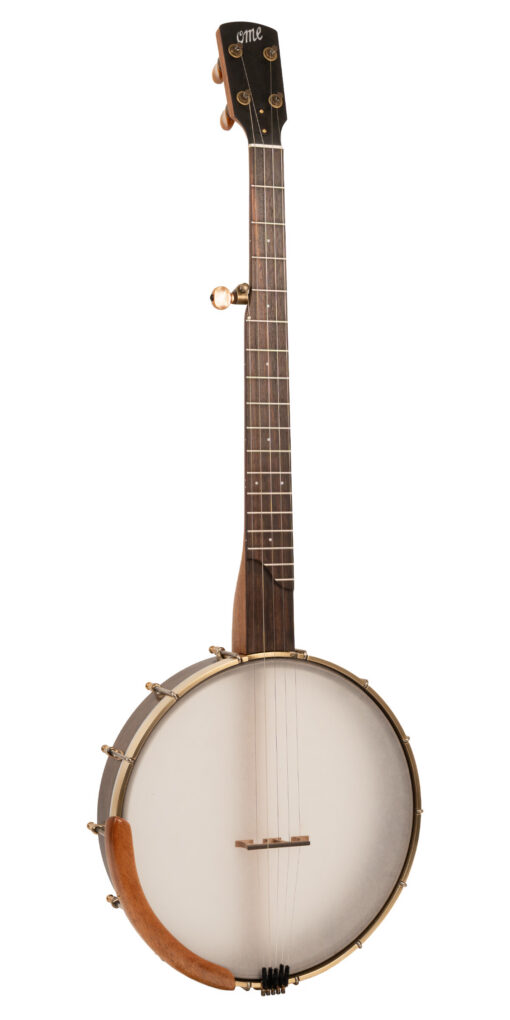
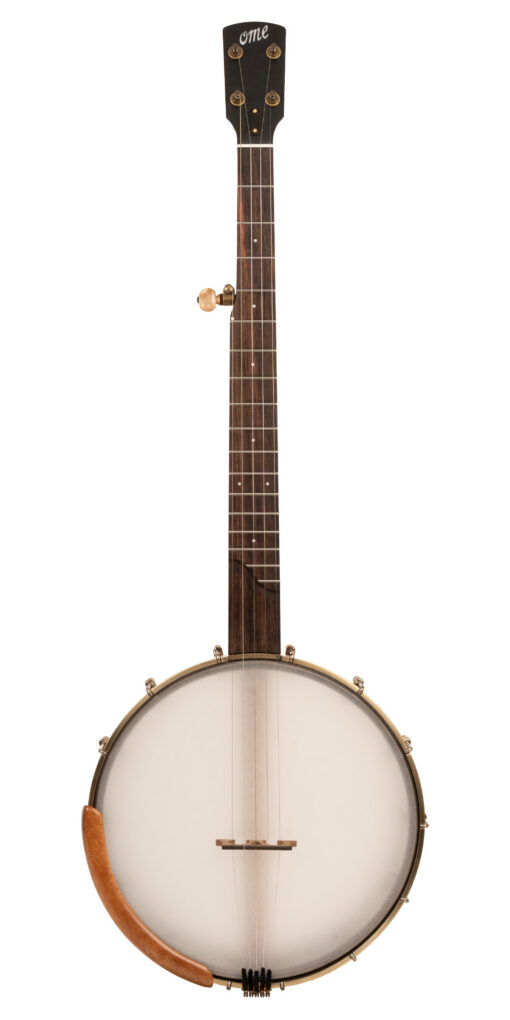
The Alpha is OME's most affordable openback: a 12 inch maple multi-ply tone rim, a mahogany neck with a scooped rosewood fingerboard, and brass hardware, voiced for clawhammer and old-time. Built by OME in Titusville, Florida, and in stock at Banjo Warehouse in Yellow Springs, Ohio. Padded gig bag included. $1,695 with free shipping.
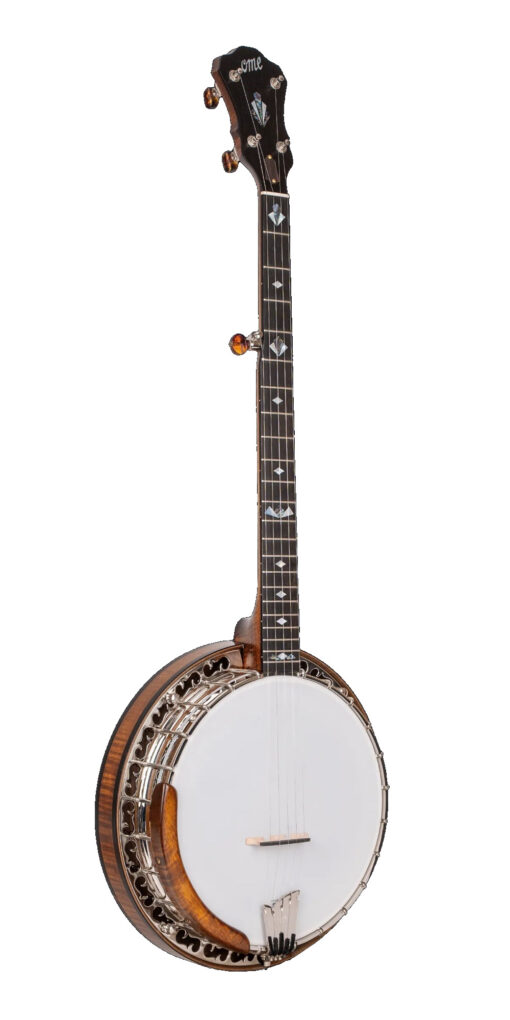

PRE ORDER: The OME Ikon is the first bluegrass resonator production model from the oldest active banjo manufacturer in the United States. JLS sand-cast bell-bronze flathead tone ring, 3-ply maple rim, 5A flamed maple neck and resonator.
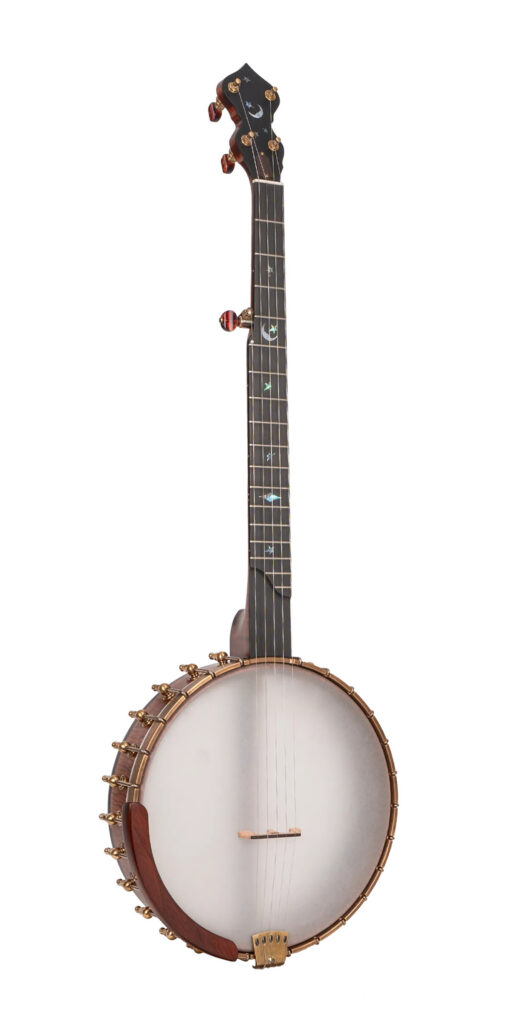
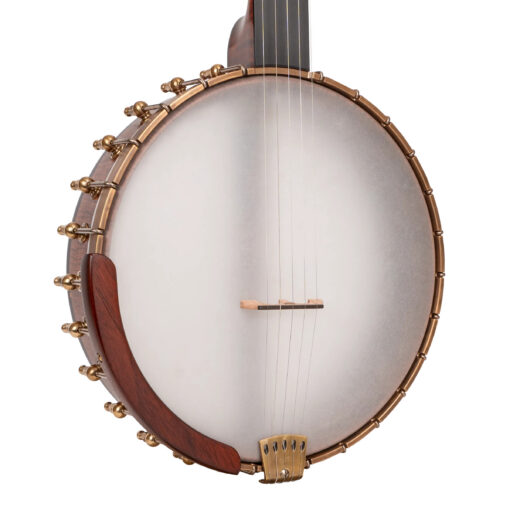
The Jubilee is OME's clawhammer banjo: an 11 inch cherry tone rim, an S-curve scoop, a double-cut headstock with a moon and stars inlay, Rickard Cyclone 10:1 tuners and 24 brackets in aged brass. Built by OME in Titusville, Florida, and in stock at Banjo Warehouse in Yellow Springs, Ohio. Case included. $2,995 with free shipping. Photos show a standard build; this banjo's specs are below.
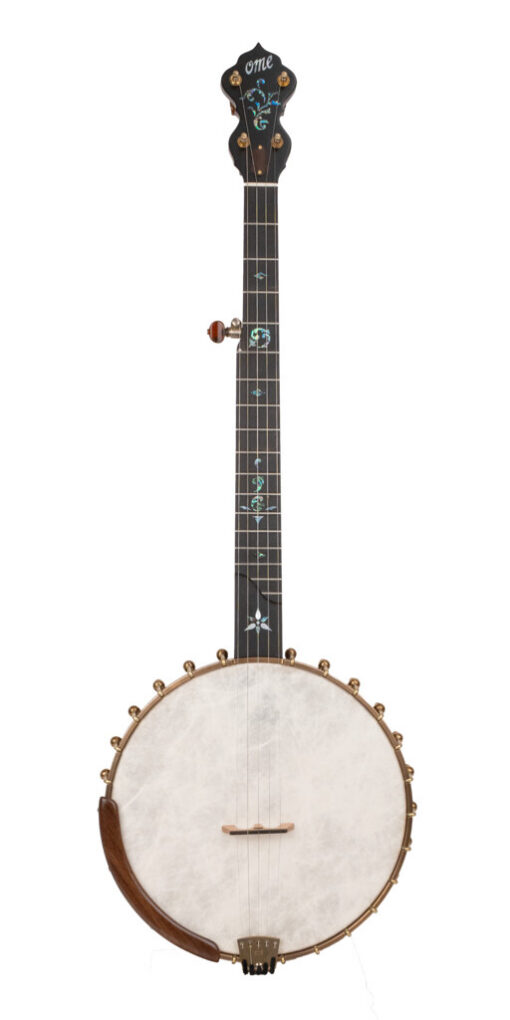
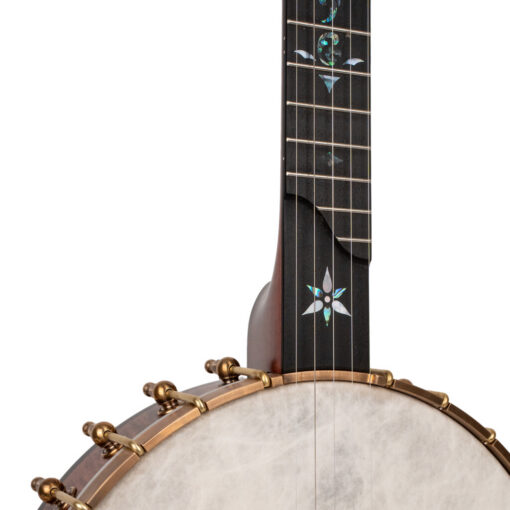
The OME Juniper Maple 12 inch is a 5-string openback banjo with a figured maple neck, a 12 inch maple rim, an ebony fingerboard with an S-curve clawhammer scoop, Rickard Cyclone tuners and aged brass hardware. Built by OME in Titusville, Florida, and in stock at Banjo Warehouse in Yellow Springs, Ohio. Free shipping. Photos show a standard build; this banjo's specs are below.
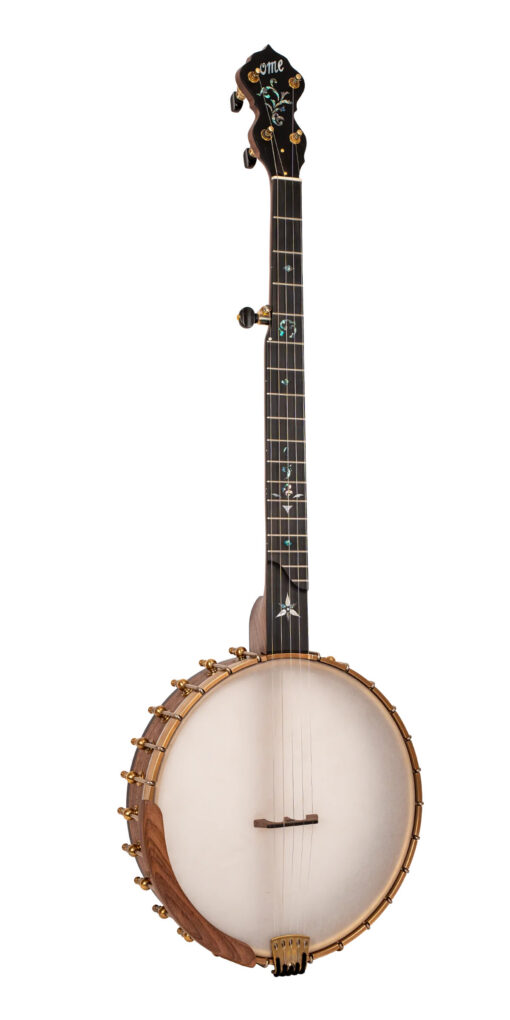
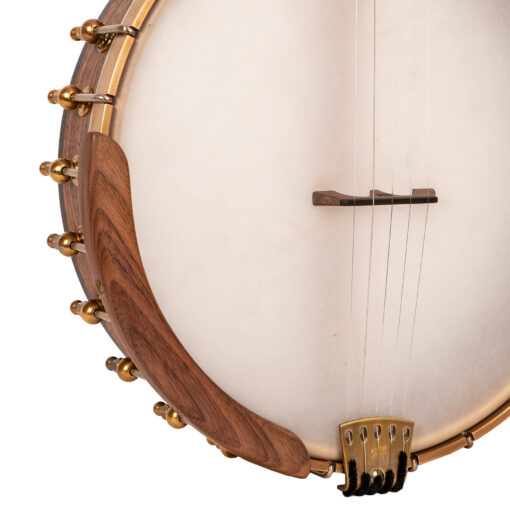
The Juniper is OME's walnut openback: a walnut neck and walnut rim with a rolled brass tone ring, a Jasmine pattern abalone inlay, an S-curve clawhammer scoop and Rickard Cyclone 10:1 tuners. Built to order by OME in Titusville, Florida. Case included. $3,195 with free shipping.
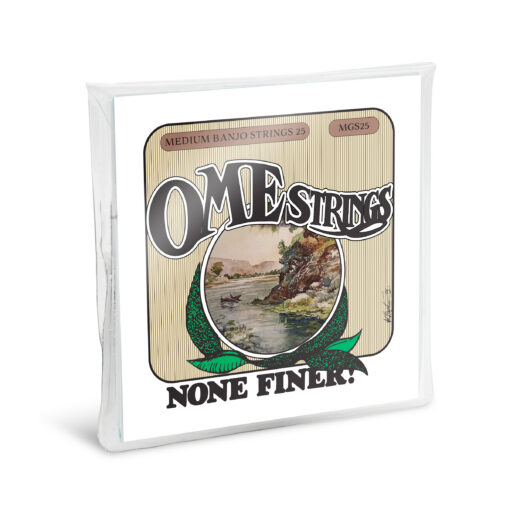
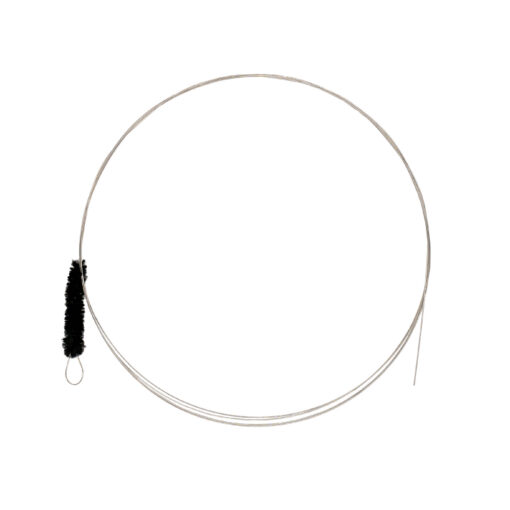
OME's own medium gauge 5-string banjo set: nickel-plated steel, loop ends, chenille-wrapped string ends. Gauges .010, .012, .015, .024w, .010. Made for 25.5" scale banjos.
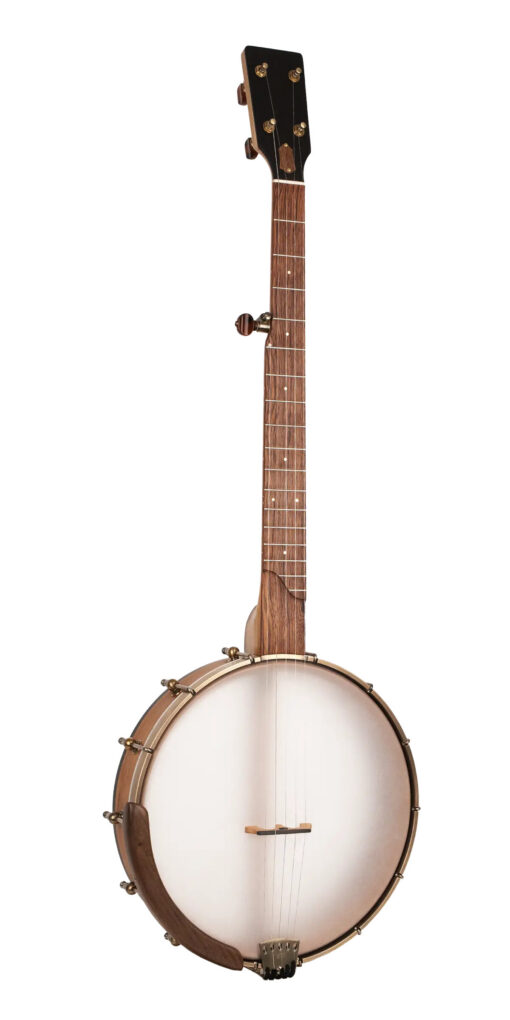
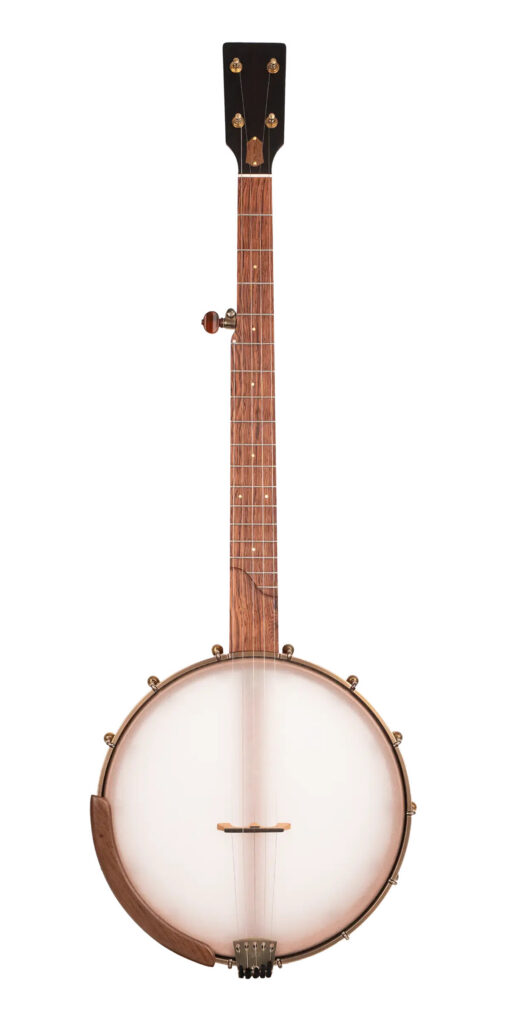
The Tupelo is OME's cherry openback: a 12 inch cherry tone rim and a cherry neck, Rickard Cyclone 10:1 tuners, an ebonite rim cap and aged brass hardware. Built by OME in Titusville, Florida, and in stock at Banjo Warehouse in Yellow Springs, Ohio. Case included. $2,495 with free shipping.

PRE-ORDER: The Vintage Ikon is the satin-finish configuration of OME's first bluegrass resonator banjo, built around OME's vintage tone ring for a warmer, more traditional voice. 5A flamed maple neck, resonator, and armrest; case included.
Now taking pre-orders — expected in store approximately September–October 2026. Full payment required at time of order.
Please note: the photos show the high-gloss Ikon. The Vintage Ikon ships in a hand-rubbed satin finish — satin photos coming soon.
Want maximum prewar bark and a high-gloss shine? See the OME Ikon with JLS tone ring at $5,999.99.
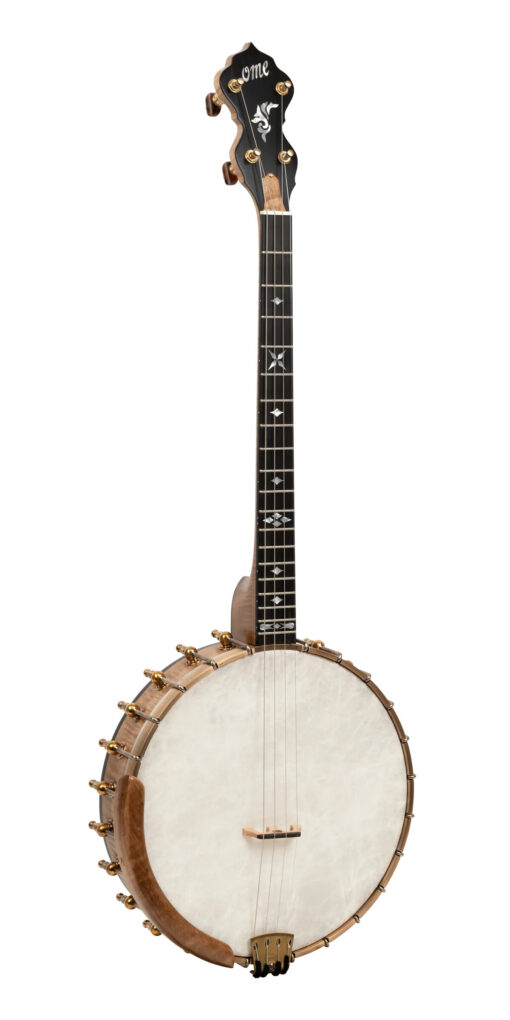
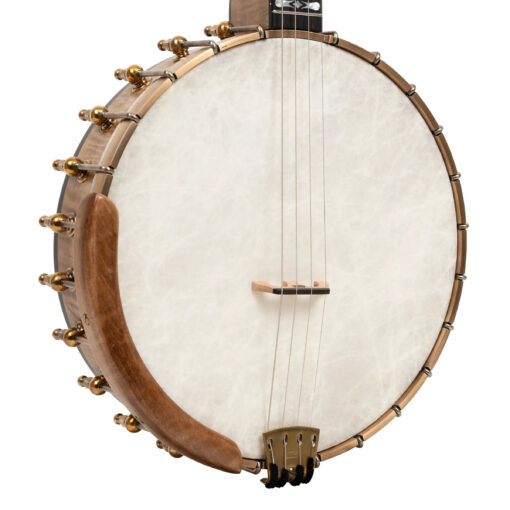
The Wicklow is OME's Irish tenor: a 4-string, 19 fret banjo tuned GDAE, with a 12 inch maple rim and a rolled brass tone ring for a clear, punchy voice in a session. Maple neck, ebony fingerboard with mother of pearl inlays, Rickard Cyclone tuners. Built to order by OME in Titusville, Florida. Case included. $2,995 with free shipping.