
How to Date an ODE Banjo
You date an ODE banjo from its serial number, but ODE used three different serial formats between 1960 and 1980, so the first job is working out which one you are looking at. The short version: if the number has two dashes in it, you are almost certainly looking at a date and not a production count. A number like 3-80-30 reads as the third month of 1980, unit 30.
That one rule clears up most of the confusion, and it is why so many ODE banjos get dated wrong online. The rest of this page walks through all three formats, where to find the number, and the two clues that people lean on that will not date an ODE on their own.
What are the three ODE serial number formats?
ODE changed its numbering twice. Each format belongs to a period of the company, so recognizing the format already narrows the date.
| Format | Example | Period |
|---|---|---|
| Plain numeric, low numbers | A short number with no dashes or letters | The Ogsbury years and the first Baldwin year in Boulder, Colorado |
| Numeric in the 2000s and up, with a letter suffix | 2984-CSR (the letters encode style and configuration) | The Arkansas years |
| Month-year-sequence | 3-80-30 | The later Booneville, Arkansas years |
How do you read a month-year-sequence ODE serial?
Read it left to right as month, year, then unit. The first number is the month, the second is the last two digits of the year, and the third is the unit’s place in the sequence.
- 3-80-30 is the third month of 1980, unit 30: March 1980. That is the serial on the 1980 ODE 6505 Style C we have in the shop now.
- 9-80-114 is the ninth month of 1980, unit 114: September 1980. That is the serial of another 1980 Style C we listed in 2024.
Both of those are 1980 banjos, and 1980 is the year ODE production wound down, which puts both of them among the last ODEs made.
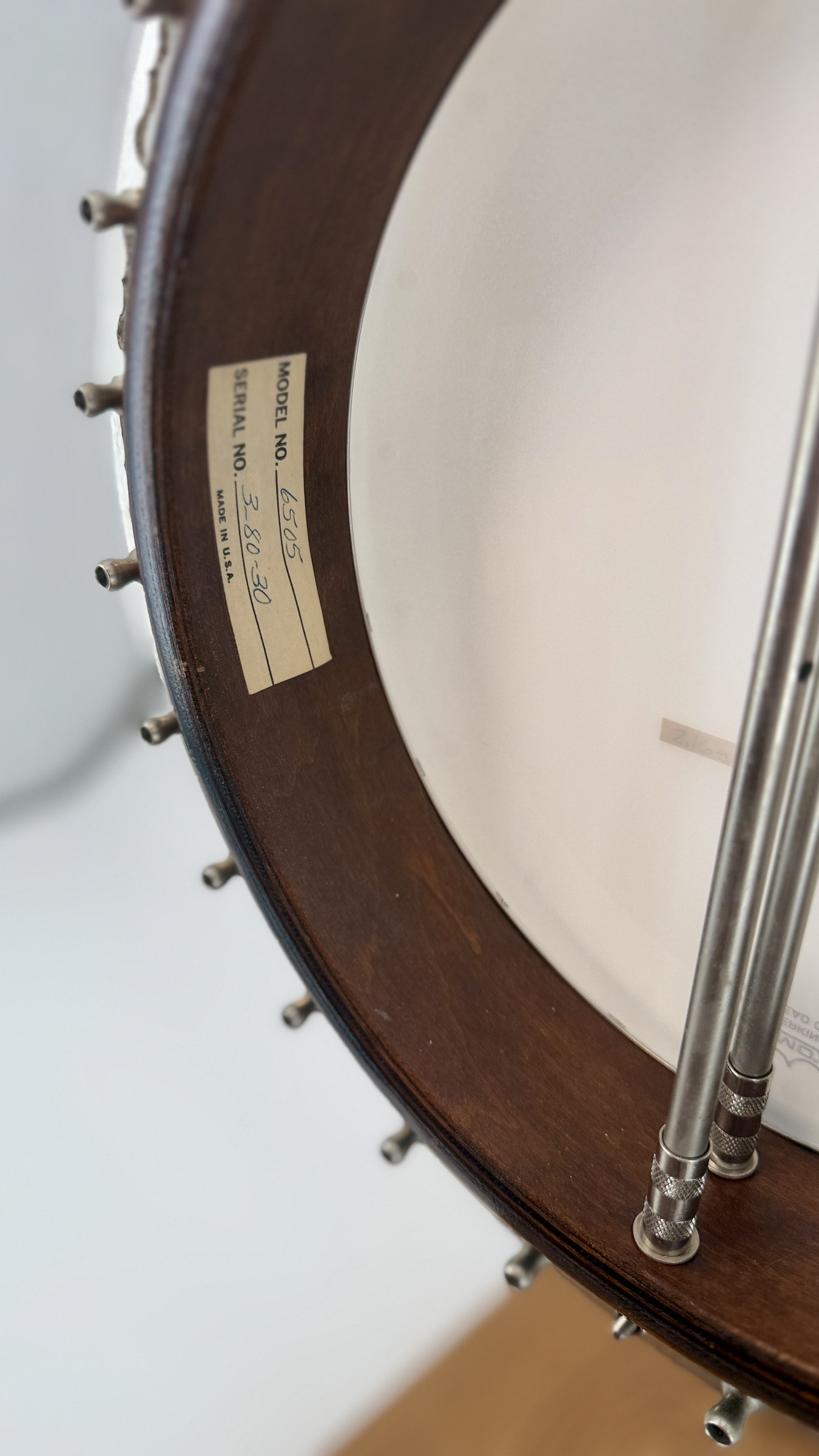
Where is the serial number on an ODE banjo?
On the 1980 Style C in the photo above, it is on a paper label inside the rim, with MODEL NO. and SERIAL NO. filled in by hand and MADE IN U.S.A. printed underneath. Take the resonator off and look at the inside wall of the rim.
If you cannot find a number, or it does not match any of the three formats, send us photos and we will take a look.
Can you date an ODE by the peghead logo?
Not on its own. Some Baldwin-era ODEs carry the Baldwin name and some, like the 1980 Style C above, say ODE on the peghead. Both brandings exist on Baldwin-era instruments, so the presence or absence of the Baldwin name is not by itself a reliable way to date one. Use the serial number.
Why does a 1980 ODE come in a Gretsch case?
Because by then ODE and Gretsch were the same company, so a Gretsch case on a late ODE is not a sign that the case was swapped.
Chuck Ogsbury founded ODE in Boulder, Colorado in 1960 and sold it to the Baldwin Piano Company in January 1966. Baldwin bought Gretsch the following year, on July 31, 1967, and in 1970 moved Gretsch production from Brooklyn to its facilities in Booneville, Arkansas. ODE production moved to Arkansas under the same ownership. By 1980 a banjo wearing the ODE name and a case wearing the Gretsch name were coming out of the same corporate operation in the same Arkansas town.
ODE banjo timeline
| 1960 | Chuck Ogsbury founds ODE in Boulder, Colorado |
| January 1966 | Ogsbury sells ODE to the Baldwin Piano Company |
| July 31, 1967 | Baldwin buys Gretsch |
| 1970 | Ogsbury starts OME in Colorado; Baldwin moves Gretsch production from Brooklyn to Booneville, Arkansas |
| Baldwin years | ODE is built in Boulder, then DeQueen, Arkansas, then Booneville, Arkansas |
| 1980 | ODE production winds down |
What is the difference between an ODE and an OME banjo?
They are two different companies founded by the same man, ten years apart, and the near-identical names cause constant confusion in listings and appraisals.
ODE ran from 1960 under Ogsbury in Boulder, then under Baldwin in Boulder, DeQueen, Arkansas, and Booneville, Arkansas, until 1980. OME started in 1970 in Colorado and is still building today in Florida. No ODE model name appears in the OME catalogs and no OME model name appears in the ODE catalogs, so if you can read the model name you can tell the two apart immediately. The peghead logo is the other giveaway.
Is anyone still making ODE banjos?
Yes. After OME, Chuck Ogsbury went on to build STARR banjos, and his son Zen Ogsbury builds ODE banjos today in the original Gold Hill shop. Banjo Warehouse is an authorized ODE dealer for the new instruments. A new ODE is a different banjo from a Baldwin-era one, so check the serial and the label before you compare prices.
Have an ODE to date, sell or appraise?
Send us the serial number and a few photos (the peghead, the rim label or stamp, and the whole banjo front and back) and we will tell you what you have. If you are thinking of selling, we buy banjos. Or call or text Geoff Hohwald at (404) 218-8580.
Want to know when vintage banjos like these arrive? Join our email list.