
History
What Is a Top Tension Banjo? Inside Gibson’s 1937 Redesign
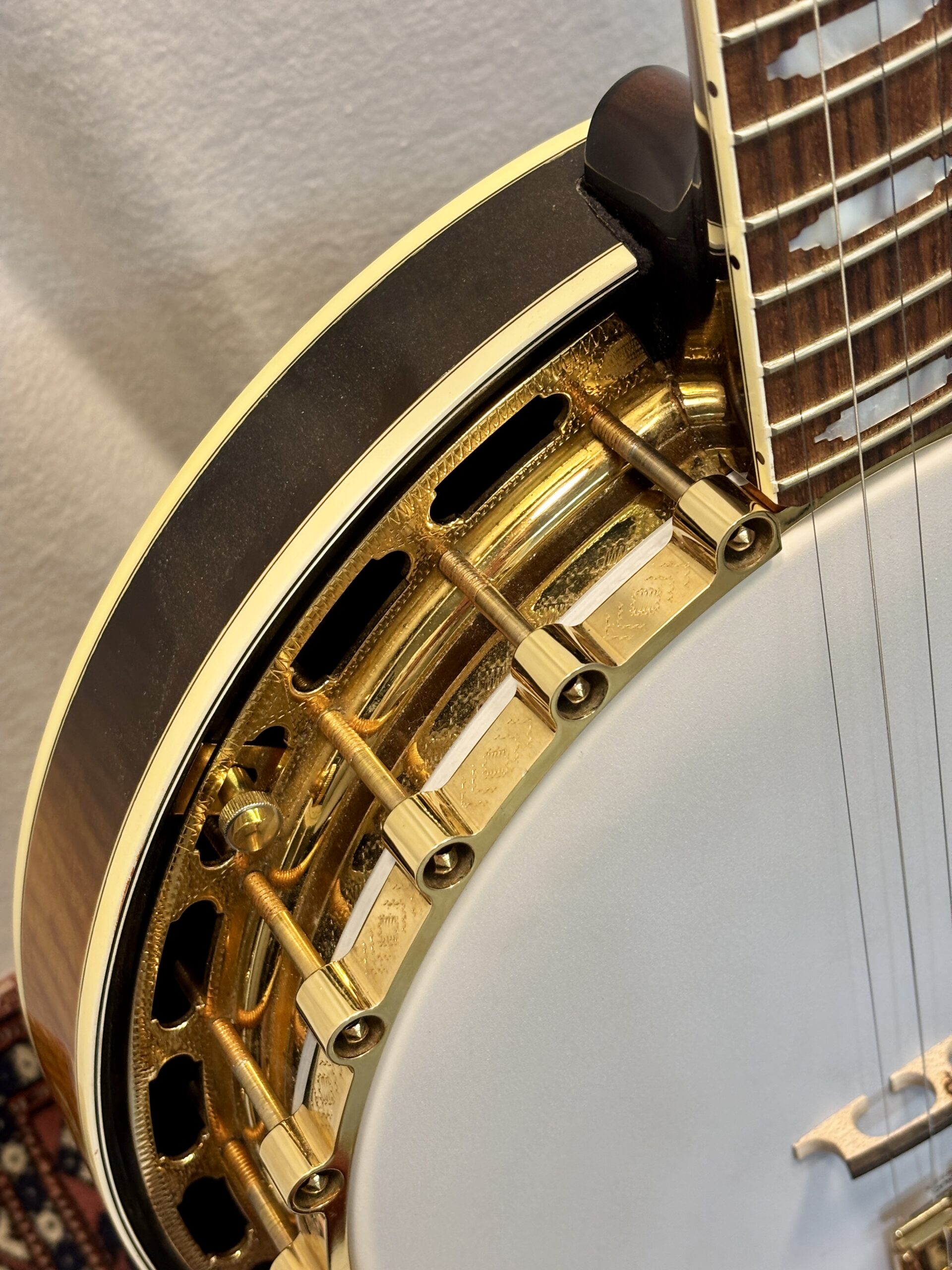
A top tension banjo is one where you tighten the head from the top of the pot instead of from underneath, so you never have to take the resonator off to adjust it. On a conventional resonator banjo the tensioning nuts sit inside the pot, facing down, and reaching them means removing the resonator first. On a top tension, bolts drop in from above and thread into the flange, and you turn them with a wrench while the banjo is fully assembled.
That is the whole mechanism. What makes top tension banjos interesting is everything Gibson changed along with it, and what those changes did to the sound.
Gibson’s Own Words, 1937
The design was introduced in Gibson’s Catalog Y in 1937, under the heading “3 New Banjos by Gibson.” The pitch was not subtle:
The world needs a new banjo, one that fits in with the modern ideas of tone, design and construction, a banjo that dares to be startlingly different. These new Gibson Banjos are the alarm clock that is going to wake up new possibilities in banjo playing.
On the top tension head itself, the catalog was specific about what it was for:
It is not necessary to remove the resonator to tighten the head. The new Top-Tension makes it easier to keep the head at a correct, even tension at all times. The result is a finer tone and less head breakage.
That last phrase is the part modern players tend to miss. Everyone played calfskin then, calfskin moves with humidity and temperature, and a head left at uneven tension could tear. Top tension was a maintenance feature before it was ever a tone feature.
Why Gibson Built Them
By 1937 the banjo boom of the 1920s was over. The guitar had taken the tenor banjo’s place in popular music and the Depression had cut sales badly. Gibson responded by overhauling the entire banjo line. Every existing “Mastertone” model was discontinued except style 3, which was reduced in price and renamed style 75. Everything else was replaced by the three new top tension models.
What Else Changed
The top tensions were a redesign, not just a new bracket arrangement. Gibson introduced several things at once, and gave each one a name:
- The Tone Chamber. Gibson’s 1937 description was “a new design with the bearing at the extreme outside of the head giving a wider vibrating surface.” That is the flathead tone ring, described before anyone called it that. The catalog adds that the casting was “a special tone-sensitive metal.”
- The carved resonator back, “carved from a solid piece of air seasoned wood, just like the famous Gibson guitar top and back.” Solid, not laminated, and flat on the inside with a hump on the back.
- The Stream-Flo neck, with a fingerboard Gibson described as “ovaled to fit the natural finger position.” We would call that a radiused fingerboard now, and it was unusual on a banjo in 1937.
- Twenty wide low action frets, for “greater range of notes.”
- Art Deco styling, with large geometric inlays and a more guitar-like peghead.
- A quickly removable armrest, so you could reach the tension bolts underneath it.
- The Wrist-Action Mute, an optional period curiosity that could be “locked on or off, or left in a neutral position.”
For players today, the most consequential detail is that these were the only pre-war Gibson banjos on which flathead tone rings were standard across the board, regardless of neck configuration.
The Three Styles
Gibson built top tensions in three styles, each in a different wood, and they tracked the models they replaced:
| Style | Wood and Finish | Hardware | 1937 Price | Replaced |
|---|---|---|---|---|
| 7 | Northern maple, rich chocolate brown | Nickel plated | $110 | Style 3 |
| 12 | Black walnut, natural walnut finish | Chrome plated | $175 | Style 4 |
| 18 | Curly maple, Cremona brown with golden sunburst | Gold plated and engraved | $200 | Granada |
Prices are from the 1937 catalog, without the optional mute. They were produced only from late 1937 into the early 1940s, and not in large numbers. Original pre-war top tensions are rare and priced accordingly when they come up for sale.
Why They Sound Different
Players who own both will tell you a top tension sounds deeper, with more sustain, and cuts differently than a conventional banjo of the same era. Two things account for most of that, and neither is the bracket arrangement itself.
The first is mass. The tension hoop on a top tension is heavier than a standard one, with sockets machined or cast into it to take the bolts, and that extra weight sits directly around the head where it affects how the head behaves.
The second is the resonator. A thick resonator turned from solid wood with a flat inside face reflects sound differently than a laminated one. Roger Siminoff, who has written extensively on banjo and mandolin construction, has pointed to those two factors together as the source of most of the tonal difference.
So the top tension mechanism is a convenience feature. The sound comes from the rest of the redesign that arrived with it.
Do You Actually Need One?
Here is the honest answer, and it is not the one you would expect a banjo shop to give.
The problem top tension was invented to solve has mostly gone away. Modern Mylar heads do not move with humidity the way calfskin does, so most players tune the head once and leave it alone for years. If you play a plastic head, the convenience that justified the whole design is worth very little to you.
Top tensions are also heavier. Noticeably so. If you play long sets standing up, that is a real consideration, and players have sold otherwise beloved instruments over it.
What you are actually buying in a top tension today is the sound and the look that came with the 1937 redesign: the mass around the head, the carved resonator, the flathead ring, the Art Deco inlay work. Those are good reasons. “It saves time adjusting the head” is not, unless you play a hide head, in which case it genuinely does.
Top Tension Beyond Gibson
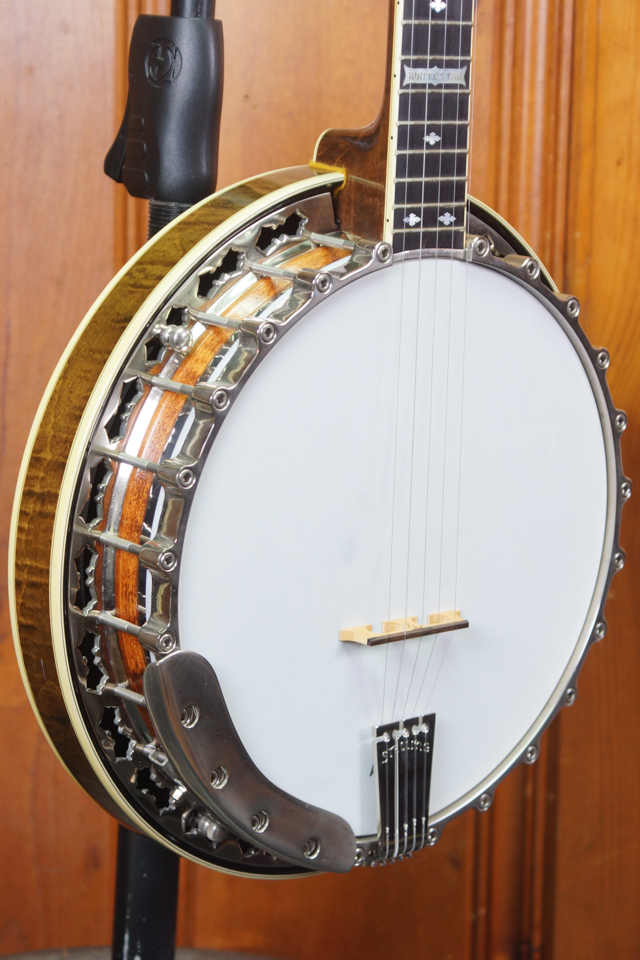
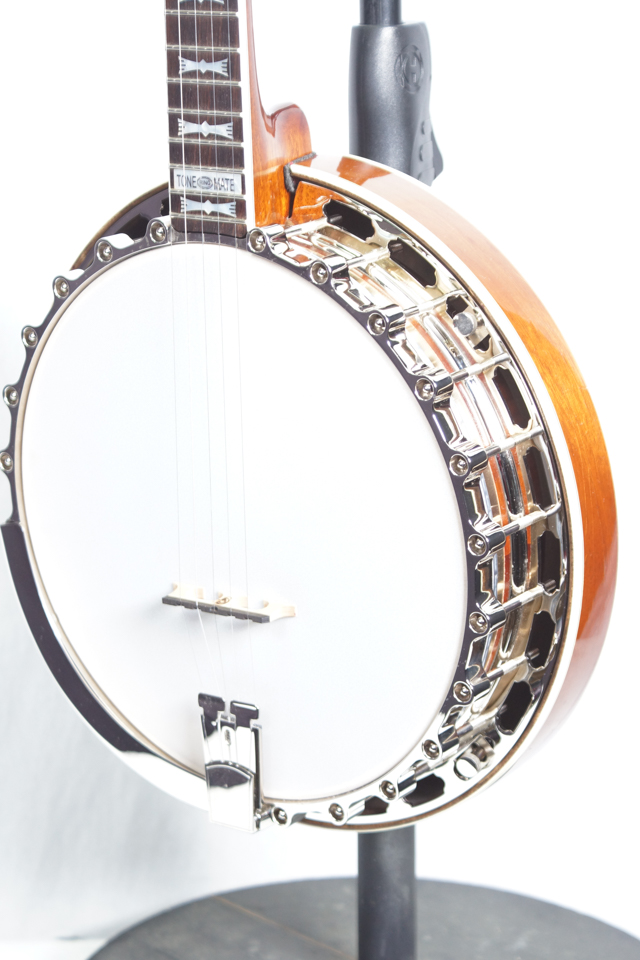
Gibson did not invent the idea and never had it to itself. Other builders worked out their own versions, before Gibson and long after, and several still do. All three of these came through our shop.

Players Known for Top Tensions
Bill Keith, Sammy Shelor and Noam Pikelny have all played top tension banjos, which is a reasonable part of why interest in them never faded even after plastic heads made the design unnecessary.
Top Tension Banjos Today
Original pre-war Gibsons are collector instruments. For a player who wants the design rather than the provenance, the modern option we carry is the Gold Tone OB-12 Top Tension, designed by Greg Rich.
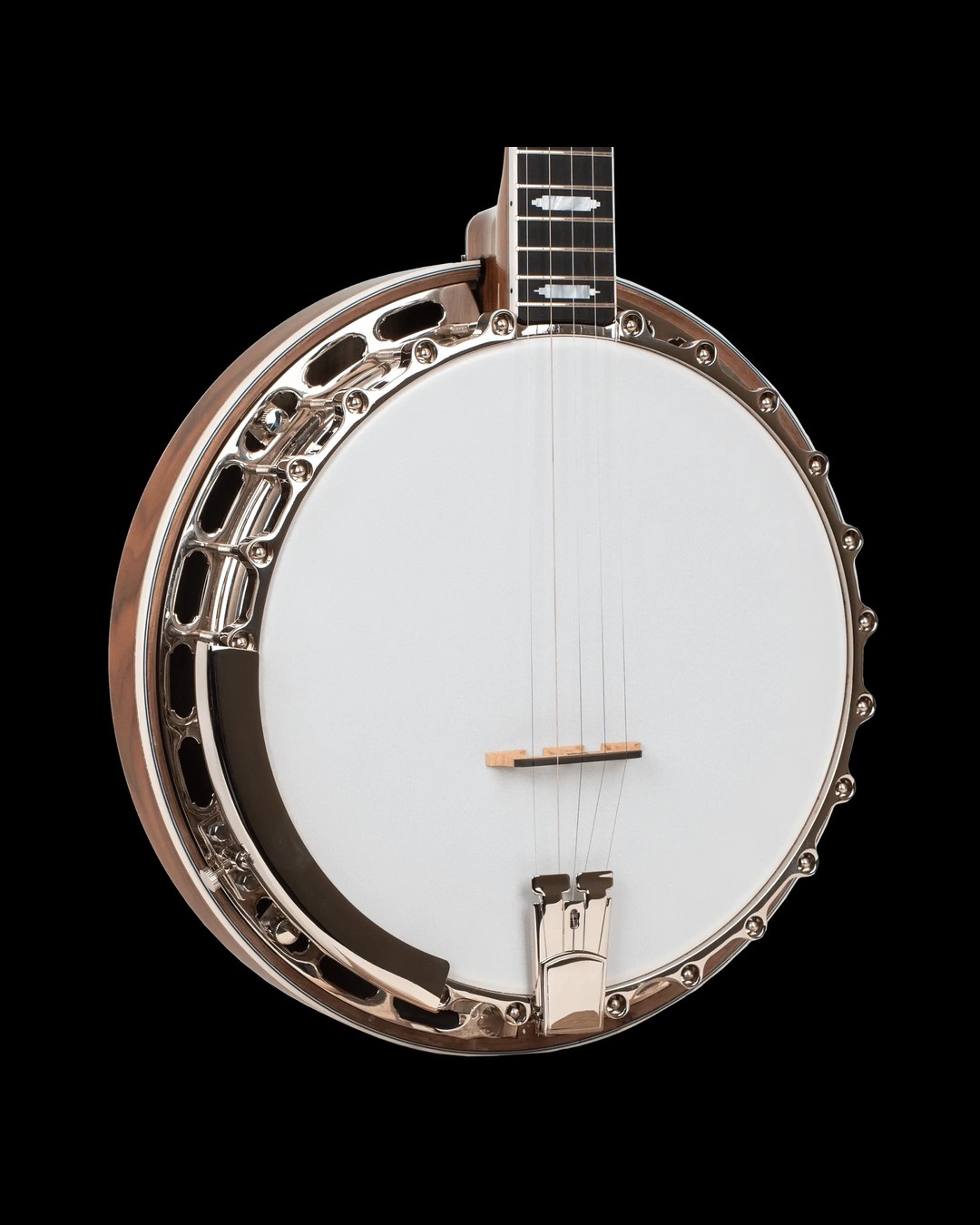
Look back at the table above and the reason it is called the OB-12 becomes obvious. Style 12 was the walnut one. The OB-12 is built from hand-selected walnut, neck and carved resonator both, because that is what a Style 12 was in 1937. The rest of it follows the same logic:
- A pre-war formula brass flathead tone ring, which is Gibson’s 1937 “Tone Chamber” idea
- An 11 inch original top tension style tension hoop
- A carved walnut resonator, following the solid carved backs of the originals
- A 12 inch radiused rosewood fingerboard, which is the modern name for Gibson’s “ovaled” Stream-Flo board
- Art Deco Style 12 inlays, matching the pattern the number refers to
- A custom top tension armrest contoured to clear the tension bolts
- Gotoh pearloid planetary tuners, a bone nut at 1 1/4 inches, a one-piece cast flange and a Prucha Presto tailpiece
Hear One
Geoff playing the OB-12 at the shop:
There is a direct connection between this banjo and our shop. Gold Tone credits Geoff Hohwald with providing the mint Gibson RB-12 that Greg Rich studied while designing the OB-12.
Every one we sell is set up by our banjo tech Tara before it ships, and a hardshell case is included. If you want to talk through whether a top tension is the right instrument for how you play, call or text Geoff at (404) 218-8580.
Frequently Asked Questions
What does top tension mean on a banjo?
It means the head is tightened from the top of the pot rather than from underneath. Bolts drop in from above and thread into the flange, so the resonator stays on while you adjust. On a conventional resonator banjo you have to remove the resonator to reach the tensioning nuts.
Do top tension banjos sound better?
They sound different, not better. The heavier tension hoop and the carved solid-wood resonator give them more mass around the head, which players describe as deeper with more sustain and a harder cut. Whether that suits you depends on what you play. Plenty of excellent bluegrass has been recorded on conventional banjos, and most modern bluegrass banjos are modeled on the conventional pre-war Gibsons rather than the top tensions.
Are top tension banjos heavier?
Yes, noticeably. The tension hoop and hardware add real weight, and the solid carved resonator adds more. If you play standing for long stretches, try one before you commit.
When did Gibson make top tension banjos?
They were introduced in the 1937 catalog and built into the early 1940s, in three styles: 7, 12 and 18. They were never produced in large numbers, which is why original examples are scarce today.
Why is the Gold Tone OB-12 made of walnut?
Because the original Gibson Style 12 was. The 1937 catalog specifies “black walnut wood selected for its richness of grain figure” with a natural walnut finish, where Style 7 was northern maple and Style 18 was curly maple with a sunburst. The OB-12 follows the style it is named after.
Do I need a top tension if I play a plastic head?
Not for the original reason. Top tension existed so players could adjust calfskin heads, which shift constantly with humidity, without pulling the resonator each time. Gibson’s own catalog sold it on convenience, even tension and “less head breakage,” all of which were calfskin problems. Mylar heads hold their tension, so it matters far less. If you play a hide head, it still matters a great deal.
Did Gibson invent the top tension design?
No. Gibson had its own system and it is the one most people mean when they say top tension, but other makers built their own versions, and several still do.
Sources and Thanks
The historical detail in this article leans heavily on the research of Greg Earnest, whose site earnestbanjo.com is the most thorough public reference on pre-war Gibson banjos there is. His work on the top tension models supplied the 1937 context, the fate of style 3, the carved resonator and ovaled fingerboard details, and the point that these were the only pre-war Gibsons with flathead rings standard across the line. If you have any interest in these instruments, go read him directly. We are a banjo shop; he is the archive.
Quotations are from Gibson’s Catalog Y, 1937. The observation about mass around the head and the turned resonator comes from Roger Siminoff.
More Reading
We wrote about Greg Rich’s first three Gold Tone designs, the OB-12 among them, in Greg Rich’s First Gold Tone Designs. If you want to understand how tone rings and flanges shape a banjo more generally, start with our OB-150 versus BG-150F comparison. And if the pre-war instruments are what you are really after, see What Is a Pre-War Gibson Banjo Worth? or browse the Greg Rich designs we carry.
